Tuesday, August 9, 2011

Worldwide number of new TB cases is higher than any other time in history

From the 2011 Lancet review:


The worldwide number of new TB cases is more than 9 million - higher than at any other time in history.


22 low-income and middle-income countries account for more than 80% of the active cases in the world.


Due to the devastating effect of HIV on susceptibility to TB, sub-Saharan Africa has been disproportionately affected and accounts for 4 of every 5 cases of HIV-associated tuberculosis.


Management problems include:


- In highly endemic areas, TB diagnosis continues to rely on century-old sputum microscopy


- No vaccine with adequate effectiveness (although BCG works to some extent). According to a recent report, BCG vaccination not only protects against tuberculosis but the number needed to treat (NNT) is 11.


- TB treatment regimens are protracted and have a risk of toxic effects


- Increasing rates of drug-resistant tuberculosis in eastern Europe, Asia, and sub-Saharan Africa


Promising progress includes improved tuberculosis diagnostics with biomarkers of disease activity. New and improved drugs, biomarkers, and vaccines need to be developed.


Diagnosing tuberculosis with cytokines IL-15, IL-10 and MCP-1, in addition to interferon-gamma


A pattern of two cytokines, called MCP-1 and IL-15, was reasonably good at differentiating between persons sick with TB and persons infected but not sick.


Monocyte chemotactic protein-1 (MCP-1) is a small cytokine belonging to the CC chemokine family. According to the new nomenclature, MCP-1 is called chemokine (C-C motif) ligand 2 (CCL2).


A third cytokine called IP-10 also showed promise at differentiating between people who are infected and those who are not.


Interferon gamma-induced protein 10 kDa (IP-10) is also known as C-X-C motif chemokine 10 (CXCL10). It belongs to the CXC chemokine family.


These 3 cytokines could form the basis of a new test to quickly detect whether tuberculosis is dormant or active and infectious.
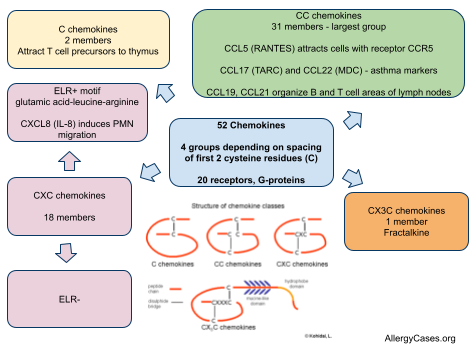


52 chemokines from 4 families have been described. They interact with 20 receptors (click here for a larger image).


References:


Tuberculosis. Stephen D Lawn MRCP, Prof Alimuddin I Zumla FRCP. The Lancet, Volume 378, Issue 9785, Pages 57 - 72, 2 July 2011.

Xpert MTB/RIF is a rapid diagnostic test for tuberculosis with high sensitivity (90%) and specificity (99%). Lancet, 2011.
Image source: PPD, CDC, public domain.


Comments from Twitter:


@sdietrich17: How discouraging. We just keep going backwards with so many infectious diseases...

Monday, August 8, 2011

Varicose veins: an animation


From NHSChoices YouTube channel: This animation explains in detail what varicose veins are, their causes, symptoms and the various treatment options.

Thursday, August 4, 2011

Doctors are natural communicators - social media is extension of what they do every day

Doctors are natural communicators

My Google+ Circle labeled "Social Media in Medicine" now has 140 members - just one month after Google+ was launched. I think that's great.

Doctors are natural communicators and should do very well on social media platforms. Patients, and society in general, would only benefit from physicians who share ideas and focus on education.

Simple guidance for social media use

The suggested guidance for social media use by health professionals is very simple and based on a recent book by a nurse and social media advocate:

1. Remember the basics:

- your professional focus
- the laws around patient privacy (HIPAA in the U.S.)
- the professional standards of regulatory bodies and of your employers

2. After that, explore all the different social media tools that are out there.

Will Google+ have an effect on blogging? Undoubtedly. Will it "kill" blogging, as some have suggested? Of course not.

The Cycle of Online Information

Google+ is just another communication platform that fits nicely in what I called the "The Circle of Online Information" in 2009.

Here is how to facilitate the Rise of the ePhysican who works hand in hand with the ePatient:


1. Inbox for the web, receive information. Receive updates from selected RSS feeds (Google Reader) and Twitter accounts. See the list of suggested RSS feeds and Twitter accounts at the end of this post.

2. Digital outposts, share information on social networks. Share interesting links and ideas on the 3 main social networks, Twitter/Facebook/Google+, curate the inflow of information.

3. Get feedback. Get feedback from your followers on Twitter/Facebook/Google+, see what works.

4. Publish at your homebase, blog. Write a blog post using the ideas, updates and feedback from Twitter/Facebook/Google+. Expand on them. Aim for a blog post on Monday/Wednesday/Friday.

5. Share your expert opinion. Share the link to your blog post via RSS and the 3 main social networks, Twitter/Facebook/Google+. Go back to step 1 to continue the circle.

Different styles/same goal

The two videos below show different communication styles but both are authored by physicians who use social media as extension of their everyday practice - they educate patients and colleagues and address their questions and concern.

The first video is by an orthopedic surgeon and the second by a pediatrician. They are both gifted natural communicators.


Do your patients speak "Doctor"?


Seattle Mama Doc 101 - Teething and Fever

RSS bundles of medical news

You can use the following RSS bundles to subscribe to medical news items. The bundles are exported from my Google Reader account. They update automatically several times per day. When in Google Reader, just select the ones that you find interesting and share them on Twitter. Add your own comments to some of the tweets.


Top Twitter Doctors

This is a list of the Top Twitter Doctors arranged by specialty in alphabetical order - feel free to add your own suggestions. The list is open to anybody to edit:


Comments from Google+:

Sina Neda - Good to see that the medical community is gathering on Google+, I'm still trying to find interesting people to follow in the medical field. Also want to remind everyone that is interested in MED-networking to add your Google+ and Twitter handles on the following list.

Neil Mehta - I for one would be very sad to see blogs go away. I find them to be the best place for "quiet" reflection, where you can think, write, cite, and then present to the society for feedback - a good example for social constructionism.

Art Gross - Every new social platform is always said to kill blogging. So far none of them have. Blogging is where content is created. Twitter, Google+ is where it is shared. Although the feedback on Google+ adds a new dimension and one that should add value to blogs. BLOGGING IS NOT DEAD YET! :)

Ves Dimov - "Blogging is where content is created. Twitter, Google+ is where it is shared." - Example: "The circle of online information"

Arin Basu - To some extent Google plus is essentially a microblogging/lifestreaming platform. As you wrote, it will change blogging but don't see how blogging will go away.

Related reading

Assessing Patients' Interest in Social Media: 83% used it, 56% wanted providers to use social media http://goo.gl/yD63V
The central part of medicine is patients - don't push them out of social media
Image source: OpenClipArt.org, public domain.

Wednesday, August 3, 2011

Hepatitis delta virus

From a recent review in The Lancet:

Hepatitis delta virus (HDV) is a small, defective RNA virus that can infect only individuals who have hepatitis B virus (HBV). More than 15 million people are co-infected worldwide.

There are 8 genotypes of HDV. The hepatitis D virion is composed of a coat of HBV envelope proteins surrounding the nucleocapsid.

The nucleocapsid consists of:

- a single-stranded, circular RNA genome
- delta antigen, viral protein

HDV suppresses HBV replication but also causes severe liver disease with rapid progression to cirrhosis and hepatic decompensation (liver failure).

The range of clinical presentation is wide, varying from mild disease to fulminant liver failure.

Treatment of HDV is with pegylated interferon alfa; however, response rates are poor.

Better understanding of the molecular structure of HDV may lead to new therapeutic targets for this most severe form of chronic viral hepatitis.

References:

Hepatitis delta virus. Sarah A Hughes MBBCh, Heiner Wedemeyer MD, Dr Phillip M Harrison MD. The Lancet, Volume 378, Issue 9785, Pages 73 - 85, 2 July 2011.

Tuesday, August 2, 2011

Post-splenectomy and hyposplenism - Lancet review

The spleen links innate and adaptive immunity.

The impairment of splenic function is defined as hyposplenism. The term asplenia refers to the absence of the spleen, a condition that is rarely congenital and mostly post-surgical.


Spleen. Image source: National Cancer Institute and Wikipedia, public domain.

Complications of hyposplenism and asplenia

Hyposplenism and asplenia might predispose individuals to thromboembolic events. However, infectious complications are the most widely recognised consequences of these states.

Splenectomy and hyposplenism are associated with infections by encapsulated bacteria with high mortality, fulminant course, and refractoriness to common treatment.

Prevention through vaccination and antibiotic prophylaxis is the basis of management.

References:
Post-splenectomy and hyposplenic states. Antonio Di Sabatino MD, Rita Carsetti MD, Prof Gino Roberto Corazza MD. The Lancet, Volume 378, Issue 9785, Pages 86 - 97, 2 July 2011.

Monday, August 1, 2011

Beyond "Good Job": How to Give Effective Feedback to Residents

Although too often used interchangeably, encouragement, evaluation, and feedback are quite distinct:

- Encouragement (eg, "good job!") is supportive but does nothing to improve the learner's skills

- Evaluation is summative and is the final judgment of the learner's performance

- Feedback is designed to improve future performance

References:

Getting Beyond "Good Job": How to Give Effective Feedback. PEDIATRICS Vol. 127 No. 2 February 2011, pp. 205-207 (doi:10.1542/peds.2010-3351).
Image source: OpenClipArt.org, public domain.

Sunday, July 31, 2011

Redefining age 66 - when your job description is "rockstar"

Deep Purple and Orchestra - Maybe I'm a Leo, Mainz, Germany, July 2011:


Ian Gillan, 65, is best known as the lead singer and lyricist for Deep Purple. Roger Glover, 65, is the bassist and songwriter for the group. Ian Paice, 63, is the drummer. He is the only founding member of the band who never stopped performing with the group, and the only member to appear on every album the band has released during the last 43 years (Deep Purple was founded in 1968).

This is the same group almost 40 years ago, in 1972:


I have attended two concerts of Deep Purple, the last one was in June 2011 and it was quite impressive. The audience age ranged from 5 to 75 and everyone rose to their feet to the sound of Smoke on the Water.

From Time-Colonist, Vancouver, Canada:

Welsh-born Roger Glover, now a 66-year-old grandfather, says "when you're on stage, you're still the 19-year-old boy you once were, in thrall with the music. I probably enjoy it more than I did before."

Back in the early 1970s, Deep Purple toured relentlessly. In 1972 alone, the band undertook six tours of North America and a tour of Japan — and wrote an album. Overwork sapped their joy, with the band folding (albeit temporarily) in 1976.

"Now, every night I step on stage I value it immensely. [Performing] is something very few people get to experience, therefore I can't take it for granted," Glover said.

"That's the only time when there's no distractions. There's no phone calls, there's no computers, there's no family, there's no children. There's nothing except for your music and the audience. . . . It's a lovely moment in time, and you're so in the moment. You brain is whizzing along at light speed, because you react to what the others are playing. It's a moving, liquid thing. You keep it together as possible, and also as expressive as possible."

Older and greyer, Glover nonetheless remains slim and trim. Asked whether he maintains a fitness regime, he laughed. He is, after all, still a rock 'n' roll star.

"I'm not really an exercise person. I should be," he said. "I work out on stage. Two hours every night is like two hours in a gym. It is physical."

How long can the group go on? According to Ian Gillan: “People like to do stuff that they’re good at, that they enjoy, that they get something out of. So while it’s fun and we’re all getting older and bits are dropping off here and there, it’s still great. I think there probably will be another album.”

References:

Videos from Deep Purple at Ravinia Festival 2011, 3 part series.
Deep Purple – review, The Guardian, 2011.
"During the monster-rocking ““Smoke on the Water” the middle-aged man in front of me inserted a pair of earplugs and started singing as if for all his life" http://goo.gl/OaWCa
Jon Lord says thank you for Classic Rock Innovator Award, 2011, http://goo.gl/aAFRG
Deep Purple live: 66-year-old vocalist, a plastic cast on his foot, seems to build up steam as the night goes on http://goo.gl/roZzH
Legendary UK Deep Purple band soldiers on: "We haven’t eaten for 2 days, we look at each other, and "it’s the glamour that keeps us going" http://goo.gl/N4SGV
Deep Purple not for the faint of heart. Time-Colonist, Vancouver, Canada, 02, 2012.

Comments from Facebook:

Deep Purple shows shades of youth - British hard rock group are still on the road after 40 years, a feat in itself - Toronto, 2012

I've seen Deep Purple in concert twice (2000 and 2012), Ian Gillan once, in the 1990s. Amazing energy.

They're the basis of my "How to be a Twitter rockstar" talk for physicians... :)