Showing posts with label Vascular Medicine. Show all posts

Thursday, September 22, 2011

Antiphospholipid antibody syndrome (APS)

From The Lancet:

Graham Hughes, who first described antiphospholipid syndrome (APS) in 1983, urged for more efforts to raise awareness of this disorder. APS often remains undiagnosed and untreated with catastrophic consequences, such as multiple miscarriages, or stroke at a young age.

Clinical features of APS

Clinical manifestations of antiphospholipid syndrome (APS) include:

- venous, arterial, and small-vessel thrombosis
- pregnancy loss
- preterm delivery for patients with severe pre-eclampsia or placental insufficiency
- cardiac valvular disease
- renal thrombotic microangiopathy
- thrombocytopenia
- haemolytic anaemia
- cognitive impairment

Antibodies

Antiphospholipid antibodies promote activation of endothelial cells, monocytes, and platelets; and overproduction of tissue factor and thromboxane A2 (procoagulants). Complement activation might have a central pathogenetic role.
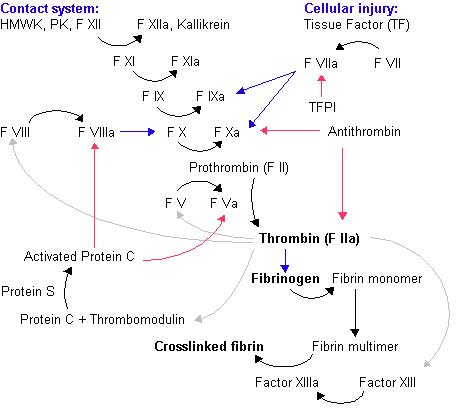

The coagulation cascade. Black arrow - conversion/activation of factor. Red arrows - action of inhibitors. Blue arrows - reactions catalysed by activated factor. Grey arrow - various functions of thrombin. Image source: Wikipedia

Of the different antiphospholipid antibodies, lupus anticoagulant is the strongest predictor of clinical presentation.

Treatment of APS

Therapy of thrombosis is based on long-term oral anticoagulation (warfarin). Patients with arterial events should be treated aggressively.

Primary thromboprophylaxis is recommended in patients with systemic lupus erythematosus (SLE) and in obstetric antiphospholipid syndrome. Obstetric care is based on treatment with aspirin and heparin.

Hydroxychloroquine is a potential additional treatment for APS. Possible future therapies for non-pregnant patients with antiphospholipid syndrome are statins, rituximab, and new anticoagulant drugs.

References

Antiphospholipid syndrome. The Lancet, Volume 376, Issue 9751, Pages 1498 - 1509, 30 October 2010.
Raising awareness of antiphospholipid antibody syndrome. The Lancet, Volume 375, Issue 9717, Page 778, 6 March 2010.


Friday, September 9, 2011

New Complication from Contaminated Cocaine - Bilateral Necrosis of the Ear Lobes and Cheeks

Interesting fact: Traces of cocaine taint up to 90% of paper money in the United States. Paper money become contaminated with cocaine during drug deals and directly through drug use, such as snorting cocaine through rolled bills. Amounts of cocaine found on U.S. bills ranged from 0.006-1,240 micrograms of cocaine per banknote (50 grains of sand) (http://bit.ly/27V5Yt).

Since 2005, levamisole (commonly used as to treat worm infections in humans and animals), has increasingly been used to mix cocaine for street use.

In 2009, 70% of cocaine seized at U.S. borders contained levamisole, causing an increase in cases of neutropenia among cocaine abusers.

Recently, researchers observed a new complication of levamisole contamination – vasculitis. Two cocaine abusers with similar cases of neutropenia and vasculitis presented to the University of Rochester Medical Center within 8 days of each other - with purplish plaques on their cheeks, earlobes, legs, thighs and buttocks. While the patients were not tested for levamisole levels, exposure was likely due to recent cocaine use.

Doctors should suspect levamisole exposure in patients presenting with both neutropenia and necrotic skin lesions.

See the dramatic photos from a similar case published in the NEJM here: Toxic Effects of Levamisole in a Cocaine User

References:
Bilateral Necrosis of Earlobes and Cheeks: Another Complication of Cocaine Contaminated With Levamisole. Ann of Int Med, June 1, 2010,  vol. 152  no. 11  758-759.

Monday, August 8, 2011

Varicose veins: an animation


From NHSChoices YouTube channel: This animation explains in detail what varicose veins are, their causes, symptoms and the various treatment options.

Thursday, August 26, 2010

Gene test decreases warfarin-related hospitalizations by 28%

Patients who received a test of two genes connected to warfarin sensitivity were 28 percent less likely to be hospitalized for a bleeding episode or blood clot than those whose safe and effective warfarin dosing was determined by traditional trial and error method.

The genetic tests, which are easily done with a cheek swab or blood sample, need only be performed once ever for each patient and cost somewhere between $200 and $400 - far less than even a brief hospital stay.


Warfarin Sensitivity Genotype Test - Mayo Clinic Video.

References:
Gene test can cut warfarin hospitalizations | Reuters.

Monday, June 7, 2010

Deep Vein Thrombosis - Videos by Cleveland Clinic and Mayo Clinic


Deep Vein Thrombosis - Cleveland Clinic.


John Heit, M.D., a cardiovascular physician at Mayo Clinic.

Oral factor Xa inhibitor apixaban - more effective than enoxaparin for thromboprophylaxis after knee replacement

Low-molecular-weight heparins such as enoxaparin are preferred for prevention of venous thromboembolism after major joint replacement. Apixaban, an orally active factor Xa inhibitor, might be as effective, have lower bleeding risk, and be easier to use than is enoxaparin.

The primary outcome in this Lancet study was the composite of asymptomatic and symptomatic deep vein thrombosis (DVT), non-fatal pulmonary embolism (PE), and all-cause death during treatment. The primary outcome was reported in 15% of apixaban patients and 24% of enoxaparin patients (relative risk 0·62), absolute risk reduction 9·3%.

Major or clinically relevant non-major bleeding occurred in 4% of patients receiving apixaban and 5% of treated with enoxaparin.

The authors concluded that apixaban 2·5 mg twice daily, starting on the morning after total knee replacement, offers a convenient and more effective orally administered alternative to 40 mg per day enoxaparin, without increased bleeding.

References:
Image source: Apixaban, Wikipedia, public domain.

Thursday, May 13, 2010

Warfarin Sensitivity Genotype Test - Mayo Clinic Video


Thomas Moyer, Ph.D., from Mayo Clinic's Department of Laboratory Medicine and Pathology, describes the four basic categories of patients as identified through this test, and how the doses of the blood-thinner warfarin would typically be adjusted to reflect differences in patients' metabolism of warfarin and also their sensitivity, to prevent stroke or hospitalization due to excessive bleeding.

Friday, February 19, 2010

Superficial Venous Thrombosis Linked to Increased Risk of "Deep" Venous Thromboembolism for Months

Superficial venous thrombosis (SVT) is perceived to have a benign prognosis.

Among 844 patients with SVT, 24.9% also had deep venous thrombosis (DVT) or symptomatic pulmonary embolism.

Among 600 patients without DVT or pulmonary embolism at inclusion who were eligible for 3-month follow-up, 10.2% developed thromboembolic complications at 3 months despite 90.5% having received anticoagulants:

- pulmonary embolism 0.5%
- DVT 2.8%
- extension of SVT 3.3%
- recurrence of SVT 1.9%

A substantial number of patients with SVT exhibit venous thromboembolism at presentation, and some that do not can develop this complication in the subsequent 3 months.

References:
http://www.annals.org/content/152/4/218.short
Image source: Saphenous vein, Gray's Anatomy, 1918 (public domain).