Showing posts with label Research. Show all posts

Saturday, January 21, 2012

Blogging is good for you - and for most people who read blogs

From The Economist:

"Academic papers cited by bloggers are far more likely to be downloaded. Blogging economists are regarded more highly than non-bloggers with the same publishing record.

The back-and-forth between bloggers resembles the informal chats, in university hallways and coffee rooms, that have always stimulated economic research, argues Paul Krugman, a Nobel-prize winning economist who blogs at the New York Times. But moving the conversation online means that far more people can take part.

Despite the low barriers to entry, blogs do impose some intellectual standards. Errors of fact or logic are spotted, ridiculed and corrected. Areas of disagreement are highlighted and sometimes even narrowed."

Similar dynamics are in work on many medical blogs authored by physicians.

WIN-WIN, as the author of the blog "The Happy Hospitalist" likes to say.

References:

Economics blogs. A less dismal debate. The Economist, 01/2011.

Thursday, May 26, 2011

The 10-year rule: you must persevere with learning and practising for 10 years before making breakthrough

From The Lancet:

Hard work is required: “Genius is one per cent inspiration, ninety-nine per cent perspiration” - Thomas Edison

Late in life, Charles Darwin made the same point in a letter to his son: “I have been speculating last night what makes a man a discoverer of undiscovered things, and a most perplexing problem it is.—Many men who are very clever,—much cleverer than the discoverers—never originate anything. As far as I can conjecture, the art consists in habitually searching for causes or meaning of everything which occurs.” Darwin was a relentless student of nature from 1828 until the few weeks in late 1838 when he suddenly perceived the mechanism of evolution by natural selection.

There can be no doubt that geniuses have worked habitually and continually. Darwin produced 160 published papers, in addition to celebrated books and a vast correspondence. Albert Einstein had 240 publications, Sigmund Freud 330, Henri Poincaré 500 papers and 30 books; Edison was the owner of 1093 patents, lodging an average of one patent every 2 weeks of his adult life. In the arts, J S Bach on average composed 20 pages of finished music per day, while Pablo Picasso created more than 20,000 works.

Experience is essential: “Where observation is concerned, chance favours only the prepared mind” - Louis Pasteur

The 10-year rule states that a person must persevere with learning and practising a craft or discipline for about 10 years before he or she can make a breakthrough. The initial scientific evidence for the rule came from studies in the 1960s and 1970s of chess-players, who take 10 years and more to become masters of the game. Then it was found to apply to Olympic swimmers and concert pianists.

Hardly any genius in history—not even Leonardo da Vinci—seems to have short-cut the long and gradual path to creative breakthroughs.

References

Perspiration, inspiration, and the 10-year rule. The Lancet, Volume 376, Issue 9751, Pages 1458 - 1459, 30 October 2010.

Twitter comments:

@equijada: the ability to infer disparate ideas into one is the 1%. The rest is just salty water. 10-yrs, 10,000 hrs -> playing w/ observations

Wednesday, February 2, 2011

Strategies for Increasing Recruitment to Randomised Controlled Trials

Recruitment of participants into randomised controlled trials (RCTs) is critical for successful trial conduct.

396 papers were retrieved and 37 studies were included in this review.

Recruitment strategies that improved recruitment included:

- increased people's awareness of the health problem being studied (e.g., an interactive computer program)
- attendance at an education session
- addition of a health questionnaire or a video about the health condition
- monetary incentives

Increasing patients' understanding of the trial process, recruiter differences, and various methods of randomisation and consent design did not show a difference in recruitment.

References:

Caldwell PHY, Hamilton S, Tan A, Craig JC (2010) Strategies for Increasing Recruitment to Randomised Controlled Trials: Systematic Review. PLoS Med 7(11): e1000368. doi:10.1371/journal.pmed.1000368
Recruiting Study Participants Through Facebook: Epidemiology Study, 2011.
Facebook is cost-effective recruitment source for smokers to complete a survey about tobacco and other substances http://goo.gl/F4Dcb
Image source: picturestation.net, free license.

Saturday, July 31, 2010

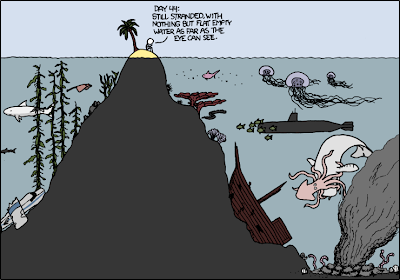
Not what it seems: Desert Island


Not what it seems: Desert Island (click to enlarge the image). The obvious is sometimes hidden - this often applies to clinical evaluation of patients and research.

References:
http://xkcd.com/731

Monday, April 19, 2010

The false idea that only the “top journals” publish the important stuff

From the former Editor-in-Chief of BMJ:

The naïve concept that the “top journals” publish the important stuff and the lesser journals the unimportant is simply false. People who do systematic reviews know this well. Anybody reading only the “top journals” receives a distorted view of the world. Unfortunately many people, including most journalists, do pay most attention to the “top journals.”

References:

Richard Smith: Scrap peer review and beware of “top journals”. BMJ Blogs.

Google ranks the top 100 journals and NEJM is no more the "top dog" according to G Scholar Metrics for Publications http://goo.gl/unTjs

Comments from Google Buzz (March 22, 2010):

Heidi Allen - Love the fact that the BMJ have put out so bold a statement

Neil Mehta - Very provocative. Agree that Peer review is mostly a joke and a lottery. Unfortunately we still live in a world of publish or perish. We need to have something like a YouTube of papers. As more people read these and rate them, the cream will rise to the top. The raters should also be rated and that should also count towards academic promotion.

Lakshman Swamy - Neil-- I agree, but it should be a closed system. Anyone can read, but not anyone can rate-- have to have credentials of some sort. Can't risk creating another place for opinions to become stronger than data.

Ves Dimov, M.D. - On a more basic level, this is also a simple appeal to all physicians to read more than the top 5 journals. Wait... Most physician don't even read the top 5 journals.. :)

Social networks help in some way though - I tend to have a closer look at articles linked by the people I follow.

Vamsi Balakrishnan - @Neil Mehta A friend and myself actually shared that same idea about science, about publishing and its current state. We had a grandiose goal of starting a publishing site that would be more about sharing ideas than anything else (www.sciencetrader.com/).

When I think about publishing in famous journals being important, I think about the famous "cloner" who published in Nature (http://en.wikipedia.org/wiki/Hwang_Woo-Suk); if peer-review was successful, I doubt that he'd have been published his fabricated data. But, once you're successful and thus renowned, no one would have the courage to question you.

Kind of a similar situation is found with Einstein back in the day. When he was working on TOE (theory of everything; a unified grand scheme for how the universe works) he denied the possibility that quantum mechanics could rule the microcosm simply because of his belief that regardless of the evidence, "God does not play dice with the universe" (or something close to that). The macrocosm followed his rules exactly as he predicted, so the microcosm should do the same. No one questioned him since...it's Einstein. He's probably right. (He wasn't); I think Dr. Feynman said in his book (Surely You're Joking Dr. Feynman) it took another ~10 years before Einstein admitted he might be wrong...

Anyway, I diverge.

A last example that's more healthcare-related would be the scientist who developed valproic acid as a treatment for seizures. This scientist, Eymarde, made 30-40 drugs...every drug he made was GOLD, meaning they ALL worked. No one had as much success as he did in creating seizure medications. He could have said anything he wanted about seizures medications since he was the expert, and it was taken as the truth. Unlike most scientists out there though, he knew he was willing to admit that he's not perfect and that no one could make this many drugs work so well. So, he developed controlled studies...testing every component of the medication, only to find that the vector he used to dissolve his "drugs" in was the actual active component with anti-convulsive properties. A modern scientist...would not do anything. Publish or perish. If you just retracted every paper you've written for the last x amount of years...it'd be pretty hard to get future funding, even if you were being honest. This Eymarde did however respect his trade and his peers, so he retracted every one of his papers. After this bit of honest science, he was forgotten to the world and ridiculed.

In a completely circuitous way through three different example, I'm trying to say that I agree with you that peer review, and generally the scientific process now due to peer review is broken. Changes are needed.

Neil Mehta - Vamsi,
thanks for those examples. I was not familiar with the Einstein or the Eymarde examples - I want to publish my case series that suggests famous scientists with last names starting with E tend to make errors that they own up to several years later. Do you think that I should submit to top tier journals? Suggest Vamsi for peer review? Just kidding. Enjoyed reading your comments.
Look forward to more conversations

Vamsi Balakrishnan - Oh, wow, I didn't even notice the common endings. I went searching for a third "E" named person...but couldn't find one that is...on par with the Woo-Suk one.

If I write a book, it's going to be a collection of stories about famous scientists and the things that they...endured and the follies they've made.

It will be entitles, "Famous Scientists: The Things They Endured, and the Follies They've Made."

Aidan Finley - http://www.nature.com/nature/history/timeline_1950s.html The Krebs Cycle paper was rejected by Nature for not being impactful.

http://www2.uah.es/jmc/ai56.pdf (article reviewing other major rejected discoveries, including the MRI). Nature editorial: http://www2.uah.es/jmc/

Ves Dimov, M.D. - "The Krebs Cycle paper was rejected by Nature for not being impactful."

Isn't this just amazing? Reality is truly stranger than fiction.... :)

Aidan Finley - To be fair, I think everyone recognizes it was a mistake.

Related reading:

Nature rejected/declined Krebs cycle paper in 1937 - there were too many submissions - but few remember them now... http://goo.gl/mcxPd
The grossest failures of peer review (PDF) http://goo.gl/3ovkn
Image source: 2009 cover of the journal BMJ, low resolution, fair use.

Friday, April 9, 2010

Why Twitter may not be good enough for scientific information and discussion

I appreciate the re-tweet below but I did not say anything remotely close to this sentence:

@sevinfo Reading "top" journals only distorts your world - Argument for scrapping peer review at BMJ blogs via @DrVes & @KentBottles

http://twitter.com/sevinfo/status/10929698882

My original tweet:

@DrVes The naïve concept that the “top journals” publish the important stuff and the lesser journals the unimportant http://goo.gl/utJ5

http://twitter.com/DrVes/status/10892767666

My expanded citation on Google Buzz:

The false idea that only the “top journals” publish the important stuff

From the former Editor-in-Chief of BMJ:

The naïve concept that the “top journals” publish the important stuff and the lesser journals the unimportant is simply false. People who do systematic reviews know this well. Anybody reading only the “top journals” receives a distorted view of the world. Unfortunately many people, including most journalists, do pay most attention to the “top journals.”

http://blogs.bmj.com/bmj/2010/03/22/richard-smith-scrap-peer-review-and-beware-of-%E2%80%9Ctop-journals%E2%80%9D/

http://www.google.com/buzz/110859855629071891085/TPmyVKjvZS9/The-false-idea-that-only-the-top-journals-publish

Please click the Buzz link above to see how much more "richer" the comments there are as compared to Twitter where the microblog updates (tweets) are limited to 140 characters.

This little example adds to the opitinion that many times Twitter is not good enough for scientific information and discussion.

Follow-up:

@sevinfo: yoicks! I was agreeing to need to read both "top" & less exciting ; not saying that reading science distorts your world! For record - @DrVes points out that text on last link open to misinterpretation - Keep reading science journals both top & less glamourous!

Comments from Google Buzz (March 23-24):

Kathy Mackey - Appreciate the followup Dr. Ves. I read the article yesterday on BMJ on scientific journals and felt I was missing something. It is true that 140 characters can be difficult to relay important information to the public

Brian Ahier - This is a problem that can not be adequately addressed because of the character limitation in Twitter. But it is an opportunity for a service like Buzz to be a bridge for longer commentary and discussion. I suggest we have more conversations in Buzz and then tweet a link to the post.

Ves Dimov, M.D. - Agree. Works very well with some posts. However, the Buzz adoption rate is significantly lower than Twitter and seems to have plateaued a few week after its launch.

Brian Ahier - Quality vs. Quantity?
I have found a much higher quality conversation seems to be happening on Buzz. Perhaps some of the adoption will not be missed. I have yet to be bothered by a spam account on Buzz and many of the followers on Twitter soon become inactive.

Ves Dimov, M.D. - True. People put more thought into Buzz comments - the accounts are often tied to their "real" identity after all. Participation fatigue is a common occurrence among all services.

Brian Ahier - I am also fortunate that many of my higher profile followers like Tim O'Reilly, Richard MacManus, and Robert Sconle are active on Buzz. As Buzz matures I think we will see some interesting applications. Then when Google buys Twitter we'll be all set ;-)

Ves Dimov, M.D. - Yes. Although Evan Williams keeps saying that Twitter is not for sale not matter what the price...

Brian Ahier - Yeah, Ev is an idealist :-D

Ves Dimov, M.D. - You have to respect the guy - he brought two very important services to popularity and success - Blogger and Twitter. Even one would be enough for the Internet history books... :)

Ves Dimov, M.D. - @Brian Ahier - I'm sorry I deleted your comment by mistake and there is no "Undo" in Buzz. "You" was meant in general not for you in person. And, yes, I share the same opinion.

Brian Ahier - Buzz does need an undo - but as I said, I admire people who old to their ideals. Ev has made some outstanding contributions and has an amazing talent.

Neil Mehta - Some of my best online experiences have been on Buzz - feels like a civilized sit down dinner with a conversation. Twitter can leave one feeling like everyone is rushing around on a big field shouting "hello" to the world, hoping someone will reply and start a conversation - it is great when to find that stranger with whom you share an interest but that happens rarely and the conversation is usually very unsatisfactory. Understand the Twitter functionality was not designed for conversations......

Vamsi Balakrishnan - @Neil Mehta: It's exactly as Dr. Ves said though; Buzz is tied to your real identity more or less, which is especially true for those who have verified profiles. It's also easier to have conversations since there's no 140 character limit...and it goes to those who use twitter anyway if you've enabled it. So, for me at least, it was a seamless transition.

The only problem that exists though, which truth be told hasn't affected me yet, is that there's a 300 comment limit. 300 replies to a post can exist, no more.

Tuesday, April 6, 2010

How does clinical evidence work?


Ben Goldacre's Moment of Genius on BBC4 radio:

"Clinical trials in medicine are designed to be free from bias. They test, as objectively as possible, the effectiveness of a particular intervention.

When you bring the results of all these individual trials together, however, how do you weigh up what evidence is relevant and what is not? In 1993, a method of "systematic review" was introduced that enables us to get the clearest possible view of the evidence."

Monday, April 5, 2010

Video: Why submit your research to the BMJ?


The BMJ has produced a short video to help you find out about getting research published there. It includes interviews with published authors and clips from some of the short films that accompany important research articles.

The two current heavyweight world boxing champions both have PhDs, believe or not

Believe or not, but the two current heavyweight world boxing champions both have PhDs... The two researchers are the Ukrainian heavyweight boxers and brothers Wladimir and Vitali Klitschko.


Wladimir Klitschko, called "Dr. Steel Hammer"(born 25 March 1976, Semipalatinsk, Kazakhstan), currently holds the IBF, WBO, IBO and Ring Magazine world heavyweight titles. His older brother, Vitali Klitschko, is the current WBC world heavyweight champion.

In the summer of 1996, Klitschko finished Pereyaslav-Khmelnitsky Pedagogical Institute (Ukraine) and was accepted in the postgraduate study program of Kiev University. On 18 January 2001 in a conference hall of Kiev University of physical science and sports, Klitschko presented his doctoral dissertation and was awarded a Ph.D. in Sports Science. Klitschko speaks four languages: Ukrainian, Russian, German and English.

Image source: Wikipedia, GNU Free Documentation License.


Vitali Klitschko, called "Dr. Ironfist", (born 19 July 1971 in Belovodsk, Kirghiz SSR, Soviet Union (now Kyrgyzstan) is a Ukrainian professional heavyweight boxer and the current WBC world heavyweight champion. He has the highest knockout percentage (94.9%) of any heavyweight boxing champion in overall fights.

Vitali is the first professional boxing world champion to hold a Ph.D. In 1996, he graduated from the Pereyaslav-Khmelnytsky Pedagogical Institute (Ukraine) and was accepted into the postgraduate study program at Kiev University. On 29 February 2000, he presented his doctoral thesis on "talent and sponsorship in sports" at the Kiev University of Physical Science and Sports, and his Ph.D. in Sports Science was conferred.

Image source: Wikipedia, GNU Free Documentation License.

Wednesday, March 31, 2010

Anesthesia 2.0: Web 2.0 in anesthesia education

Educators in all specialties of medicine are increasingly studying Web 2.0 technologies to maximize postgraduate medical education.

Web 2.0 technologies include:

- microblogging
- blogs
- really simple syndication (RSS) feeds
- podcasts
- wikis
- social bookmarking and networking

Although direct practice and observation in the operating room are essential, Web 2.0 technologies hold promise to innovate anesthesia education and clinical practice such that the resident learner need not be in a classroom for a didactic talk, or even in the operating room to see how an arterial line is properly placed.

Web 2.0 and advanced informatics resources will be part of physician lifelong learning and clinical practice.

References:
Anesthesia 2.0: Internet-based information resources and Web 2.0 applications in anesthesia education. Chu LF, Young C, Zamora A, Kurup V, Macario A. Curr Opin Anaesthesiol. 2010 Jan 19. [Epub ahead of print]
http://www.ncbi.nlm.nih.gov/pubmed/20090518
Image source: Wikipedia.

Monday, February 15, 2010

C-reactive protein (CRP) associated with risk of coronary heart disease, stroke, vascular mortality, and death from several cancers and lung disease

Associations of C-reactive protein (CRP) concentration with risk of major diseases can best be assessed by long-term prospective follow-up of large numbers of people.

This Lancet meta-analysis included records of 160,309 people without a history of vascular disease from 54 long-term prospective studies.

Risk ratios (RRs) were 1·23 for coronary heart disease; 1·32 for ischaemic stroke; 1·34 for vascular mortality; and 1·34 for non-vascular mortality.

CRP concentration has continuous associations with the risk of:

- coronary heart disease
- ischaemic stroke
- vascular mortality
- death from several cancers and lung disease

The relevance of CRP to such a range of disorders is unclear. Associations with ischaemic vascular disease depend considerably on conventional risk factors and other markers of inflammation.

Is is still a topic of debate is whether CRP has a causal role in the development of cardiovascular disease.

However, even if CRP might not be involved in the causal pathway of atherogenesis and plaque rupture, it may still be a valuable tool in cardiovascular medicine.

In primary prevention, lovastatin therapy was more cost effective in people with increased CRP concentrations.

The JUPITER trial recently showed that, in people with relatively normal LDL cholesterol concentrations and CRP higher than 2 mg/L, rosuvastatin reduced cardiovascular risk. Even if CRP turns out to be not directly causal in cardiovascular disease, it might be useful to identify individuals at cardiovascular risk and to evaluate the efficacy of our preventing and therapeutic interventions.

References:
C-reactive protein concentration and risk of coronary heart disease, stroke, and mortality: an individual participant meta-analysis. The Lancet, Volume 375, Issue 9709, Pages 132 - 140, 9 January 2010.
C-reactive protein and cardiovascular risk: more fuel to the fire. S Matthijs Boekholdt a b, John JP Kastelein b. The Lancet, Volume 375, Issue 9709, Pages 95 - 96, 9 January 2010.
C reactive protein concentration itself is unlikely to be even a modest causal factor in coronary heart disease - BMJ, 2011. http://goo.gl/d5lCH
Image source: C-reactive protein. Wikipedia, GNU Free Documentation License.

Monday, January 25, 2010

Web 2.0/Social media tools for scientists

@Berci asked: "Will talk about science 2.0 for scientists on Wednesday. Any suggestions what to cover beside the obvious things (RSS, Twitter, etc.)?"

Beyond the obvious:

- Google Docs for manuscript collaboration and data sharing.

- Google Trends for research. We have some very interesting data from Google Trends regarding prevalence of allergic diseases - it is very useful for hypothesis generation and is free. Google Trends use does not require an IRB approval or patient consent and therefore the research process can be quicker.

- Google Chrome has become my preferred browser, I don't store many files locally, work from the cloud (Google Docs) and move bookmarks between computers.


Video: Google Docs in Plain English.

Updated: 02/12/2010

Tuesday, December 29, 2009

Why scientific journals retract published articles?

From The Lancet:

Editors have a duty to maintain the integrity of the scientific record.

An analysis of 312 retractions from 1988 to 2008 at the Peer Review Congress in Vancouver, BC, Canada revealed the main reasons for retraction:

- fabrication (5%)
- falsification (4%)
- plagiarism (16%)
- redundant publication (17%)
- disputed authorship or data ownership (5%)
- inaccurate or misleading reporting (4%)
- honest research errors (28%)
- non-replicable findings (11%)
- not stated findings (9%)

Overall, 42% of retractions were due to scientific misconduct. In an earlier analysis, 27% of 395 articles were retracted because of misconduct.

References:
COPE's retraction guidelines. The Lancet, Volume 374, Issue 9705, Pages 1876 - 1877, 5 December 2009.

Related:

Tuesday, November 10, 2009

BMJ video: The man who pioneered the randomised controlled trial


BMJ video: "John Crofton pioneered the randomised controlled trial in a 1948 BMJ paper which looked at the antibiotic streptomycin to treat TB. Now in his 90s, Dr Crofton talks to Colin Blakemore about the importance of randomisation and blinding, and how it has helped to make medicine more evidence based."

Sunday, November 8, 2009

BMJ video: The woman who knew too much


BMJ video: Alice Stewart: The woman who knew too much.

"Alice Stewart was one of Britain's foremost epidemiologists. However her recognition came late in her career, having spent her life fighting the establishment's enshrined views.

In the 1950s when she started her work, x-rays were routinely used in foetal monitoring. It was Stewart who first showed the link between the practice and childhood leukemia. She went on to look at the effects of low-level radiation exposure - uncovering the true adverse effects of chronic exposure, and thus earning herself the enmity of the nuclear industry."

Saturday, October 3, 2009

Can you describe coefficient of variance in 140 characters?

"Can you describe coefficient of variance in 140 characters?", asked a medical librarian on Twitter:

Laika (Jacqueline)
laikas RT @shamsha: need help: can someone plz describe coefficient of variance in English? thnx!

Some people obviously can:

@HCIR_GeneG: It's a measure of variability of a data sample, without paying attention to absolute values. Can be used to compare diff. distributions.

@flutesUD: CV = Std Dev / Mean. Tells u how variable the data are regardless of their units. Lets u compare across different types of studies.

My suggestion:

Ves Dimov, M.D.
DrVes@laikas @shamsha Check the Wikipedia definition, click on the links in the description and you'll get there... :) http://bit.ly/18NnEH

In probability theory and statistics, the coefficient of variation (CV) is a normalized measure of dispersion of a probability distribution. It is defined as the ratio of the standard deviation \ \sigma to the mean \ \mu .

The inclusion of a Twitter update (tweet) in does not represent endorsement or agreement of any kind. If you are included in this post but you would like to have your tweet removed for any reason, please email me and will comply with your request the same day.