Tuesday, August 16, 2011

Hepatitis C: Teenager Jazzy's Story


NHS Choices: Teenager Jazzy was born with hepatitis C. This is her video diary about living with the condition.


Comments from Twitter:


@napernurse: Fortunate to live in UK where extensive med/psych prescriptions for HepatitisC covered by NHS. If liver transplant needed, that is covered too!

New treatments for diabetes type 2

There is urgent need for new treatment strategies for diabetes type 2.


Some new approaches include:


- Long acting (eg, once weekly) agonists of the glucagon-like-peptide-1 receptor - they improve prandial insulin secretion, reduce excess glucagon production, and promote satiety


- inhibitors of dipeptidyl peptidase 4 (DPP-4), which enhance the effect of endogenous incretin hormones


- inhibitors of the sodium—glucose cotransporter 2, which increase renal glucose elimination


- inhibitors of 11β-hydroxysteroid dehydrogenase 1, which reduce the glucocorticoid effects in liver and fat


- Insulin-releasing glucokinase activators and pancreatic-G-protein-coupled fatty-acid-receptor agonists, glucagon-receptor antagonists, and metabolic inhibitors of hepatic glucose output are also being assessed
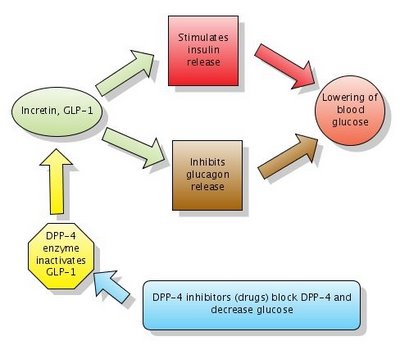


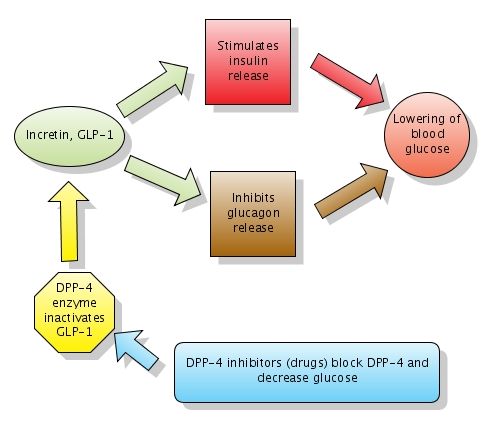
Figure 1. Action of DPP-4 inhibitors. Note that DPP-4 normally inactivates GLP-1. DPP-4 inhibitors block DPP-4 which in turn leaves GLP-1 active. Click to enlarge the figure. Created with Gliffy. The diagram Action of DPP-4 inhibitors is now on Wikipedia.


References:


Management of type 2 diabetes: new and future developments in treatment. The Lancet, Volume 378, Issue 9786, Pages 182 - 197, 9 July 2011.


Comments from Google+:


Emily Lu - Question is - how many of these treatments will actually be available to minority groups that have the higher prevalence of diabetes?


Ves Dimov - Excellent question. Check this one too: "By 2030, the number of individuals with diabetes worldwide is expected to rise to half a billion (470 million) - almost 80% of whom will be in low-income and middle-income countries. In these regions, diabetes drugs and insulin are often inaccessible or are too expensive." Early diet intervention may be the answer in type 2 diabetes.


Emily Lu - "Early diet intervention may be the answer in type 2 diabetes." -- True enough, but much much easier said than done! Patient education in general seems to me to be critical as well.


Ves Dimov - Diet is difficult to implement from patient's perspective. Activity did not bring the expected benefits in the latest trial - reported in the July 2011 issue of the Lancet.

Monday, August 15, 2011

Porphyrias

From a Lancet review:

Hereditary porphyrias represent a group of 8 metabolic disorders of the haem biosynthesis. They are characterised by acute neurovisceral symptoms, skin lesions, or both.

Every porphyria is caused by abnormal function of a separate enzymatic step, resulting in a specific accumulation of haem precursors:

- 7 porphyrias are the result of a partial enzyme deficiency
- a gain of function mechanism is present in one new porphyria

Acute porphyrias present with acute attacks - severe abdominal pain, nausea, constipation, confusion, and seizure - and can be life-threatening.

Cutaneous porphyrias present with painful photosensitivity, skin fragility and blisters.

Porphyrias are still underdiagnosed. Screening of families to identify presymptomatic carriers and avoidance of precipitants is important.

References:
Porphyrias. The Lancet, Volume 375, Issue 9718, Pages 924 - 937, 13 March 2010.

Friday, August 12, 2011

Social media tips for employees of Dartmouth-Hitchcock medical center: What you write is forever


From Dartmouth Hitchcock YouTube channel:

Social media is everywhere... and what you write is forever.

A simple rule of thumb: if you wouldn't say something in a loud voice in the crowded cafeteria, you shouldn't say it on Facebook, Twitter, or other social media sites.

When can I use social media? Even if you have your own phone and you're just sending a quick tweet, you may only use social media for personal reasons on your own time, such as during scheduled breaks or meals.

What's not allowed?

- Posting protected health information or patient identifiable information

- Using information created by or for Dartmouth-Hitchcock - such as logos, pictures, and videos - without the approval of Public Affairs and Marketing department. It's copyrighted content.

- Creating social media sites that are branded as Dartmouth-Hitchcock without the approval of Public Affairs and Marketing.


I assembled a short list of suggestion for medical bloggers several years ago. Here it is:

Tips for Medical Bloggers

- Write as if your boss and your patients are reading your blog every day
- Comply with HIPAA
- Consider using your name and credentials on your blog and other social media accounts
- If your blog is work-related, it is better to let your employer know.
- Inquire if there are any employee social media guidelines. If there are, comply with them strictly.
- Use a disclaimer, e.g. "All opinions expressed here are those of their authors and not of their employer. Information provided here is for medical education only. It is not intended as and does not substitute for medical advice."
- Get your blog accredited by the Heath on the Net Foundation

Here is how to facilitate the Rise of the ePhysican who works hand in hand with the ePatient:


Related reading

What are the Downsides of Social Media for Doctors? Dr. Wes shares insights from 6 years of blogging

Thursday, August 11, 2011

Basal Cell Carcinoma - Mayo Clinic Video


Jerry Brewer, M.D., Mayo Clinic dermatologist, describes the common form of skin cancer, basal cell carcinoma.

Secondhand smoke is nothing to kid about - CDC video


CDC: This 30-second TV ad features vignettes of children talking about when they're exposed to secondhand smoke. As the narrator points out, secondhand smoke is nothing to kid about. It can hurt lung growth and damage lung function in children. When smoking around your kids, it's like they're smoking.

Wednesday, August 10, 2011

When are you starting a Journal Club on Google Plus?

One of the BMJ blogs recently asked if Twitter Journal Club is yet another ‘revolution’ in scientific communication.

I think Twitter Journal Club is an incremental change in the way the scientists and physicians communicate. It is a good idea but limited by the medium of Twitter.

Does anybody have plans for a Journal Club on the newly-launched Google Plus? It is the fastest growing social network in history (25 million members in month) and it seems like a natural platform for that.


Arin Basu - Google + is a very natural medium for hosting journal clubs or say even grand rounds! I am more than happy to start giving it a shot!

Ves Dimov - We first tried Journal Club on Twitter in 2008 but didn't like it that much:


This 2011 version is "Twitter-only" (with a blog that provides some background) but can't go beyond the natural limitations of the medium.

Google+ seems like a better fit for a more involved discussion with a richer background. And you can actually follow the conversation...

Related reading:

Virtual Journal Club for Hospital Medicine by the Washington University in St. Louis