Visit http://MyHealthStory.me for more info. The basic idea is to share short video stories about your healthcare experiences as a patient, family member, or healthcare professional. This is done by uploading these into your own YouTube account and adding a little tag that makes the system find the videos.
The project is hosted by a team at Radboud University Nijmegen Medical Centre.
Here is a good example by ePatient Dave:
The project leader Lucien Engelen provides some background info:
Please have in mind that by recording your video story you voluntarily reveal elements of your (or your relative or friend) protected health information as defined by the HIPAA law in the U.S. This is similar to sharing your personal experience on a blog or any other website.
Showing posts with label Patients. Show all posts
Showing posts with label Patients. Show all posts
Monday, October 10, 2011

Friday, December 17, 2010
Sitting on a patient’s bed, by visitors or doctors, is prohibited by infection control
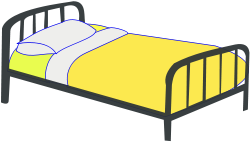 Iona Heath, general practitioner from London comments on this issue in BMJ:
"I learnt recently from senior nursing colleagues that sitting on a patient’s bed, by either visitors or clinicians, is now also prohibited, apparently in the interests of infection control. A quick internet search of "sitting on the bed" and "infection control" produces a huge list of leaflets from a variety of hospitals, each reinforcing the prohibition.
Doctors should never be discouraged from sitting, because patients consistently estimate that they have been given more time when the doctor sits down rather than stands. Standing makes the conversation seem hurried even when it is not; and, in the hospital setting, sitting on the chair does not seem to work nearly as well, because the levels are somehow all wrong."
Sitting on a chair next to the patient's bed is the best approach.
References:
Do not sit on the bed -- Heath 340: c1478 -- BMJ.
References:
Do not sit on the bed -- Heath 340: c1478 -- BMJ.
Image source: OpenClipArt.org, public domain.
Wednesday, July 14, 2010
6 (reasonable) things to do in a doctor’s waiting room
 1. Make a list of your top health concerns.
2. Write questions down.
3. Make a list of all your medications.
4. Ask the office to check on your test results.
5. Confirm that the office has the correct insurance information.
6. Read something besides the magazines.
References:
6 things to do in a doctor’s waiting room. ConsumerReportsHealth.org.
Image source: picturestation.net, free license.
Monday, May 10, 2010
Barbara Walters, US TV Anchor, to Undergo Heart Surgery to Replace a "Faulty Valve" - Sounds Like Aortic Stenosis

Walters announced that she will undergo surgery to replace a "faulty" heart valve later this week.
"You know how I always say to you how healthy I am. ... I've never missed a day's work," she began. "Later this week, I'm going to have surgery to replace one faulty heart valve."
From her description, the valve defect sounds like aortic stenosis. For a variety of reasons, mitral stenosis is a less likely possibility in the differential diagnosis.
Best wishes for successful surgery and speedy recovery!
References:
Barbara Walters to Undergo Heart Surgery. ABC.
Barbara Walters' Heart Surgery. WebMD.
Thursday, April 29, 2010
High deductible health insurance can be bad for your health
 See why:
"The individual health insurance policy they bought to replace Janie's group coverage at work has such a high deductible that they've sharply cut back doctor visits, skipping some routine care and going only when absolutely necessary.
Freelancers Janie and Chris Peterson love the freedom of life without a boss. But it comes with a high price -- dwindling savings, erratic cash flow, and a ton of financial anxiety."
References:
Financial planning for freelance workers - Mar. 11, 2010. CNN.
Image source: United States one-dollar bill. Wikipedia, public domain.

Tuesday, April 20, 2010
AskaPatient.com - Medication Ratings and Health Care Opinions
 This website "reports patient ratings and rankings of pharmaceuticals and prescription drug side effects. Database includes FDA-approved pharmaceuticals."
http://www.askapatient.com
You can Search by Drug Name:
http://www.askapatient.com/rateyourmedicine.htm
You can add ratings for the medications you take or look at ratings and comments from other patients.
For example:
cetirizine
http://www.askapatient.com/viewrating.asp?drug=19835&name=ZYRTEC
simvastatin (scores rather low)
http://www.askapatient.com/viewrating.asp?drug=19766&name=ZOCOR
You can add ratings for the medications you take or look at ratings and comments from other patients.
For example:
cetirizine
http://www.askapatient.com/viewrating.asp?drug=19835&name=ZYRTEC
simvastatin (scores rather low)
http://www.askapatient.com/viewrating.asp?drug=19766&name=ZOCOR
Please note that I am not sure how useful the site is, and obviously, this post is not an endorsement or recommendation.
Related readings:
How reliable are those patient driven rating sites? Notes from Dr. RW, 2010.
Analysis of 4,999 Online Physician Ratings: most patients gave positive reviews (2011 study) http://goo.gl/LgG5L - It begs the question: couldn't researchers add 1 more for a round number 5,000?
Analysis of 4,999 Online Physician Ratings: most patients gave positive reviews (2011 study) http://goo.gl/LgG5L - It begs the question: couldn't researchers add 1 more for a round number 5,000?
Image source: AskaPatient.com.
Thursday, March 25, 2010
Collective patient data has power to comfort, explain and predict - TED video
"When Jamie Heywood's brother was diagnosed with ALS, he devoted his life to fighting the disease as well. The Heywood brothers built an ingenious website where people share and track data on their illnesses -- and they discovered that the collective data had enormous power to comfort, explain and predict." TED Talks.
Tuesday, January 12, 2010
Patient Information
Editor: V. Dimov, M.D.
Published: 01/12/2010
Updated: 03/28/2010
If you are seeing this, you have attempted to link to the UpToDate widget but are experiencing a problem. Please visit UpToDate for more information.
Published: 01/12/2010
Updated: 03/28/2010
Video: "Dogs could be called wonder drugs"
From Cleveland Clinic:
"Dogs can provide people with many things. Protection, friendship, and unconditional love top the list, but they may also provide health benefits, too."
"Dogs can provide people with many things. Protection, friendship, and unconditional love top the list, but they may also provide health benefits, too."
Related:
Saturday, January 9, 2010
Monday, December 28, 2009
NPR: Patients Turn To Online Buddies To Help Healing
61% of adults say they look online for health information. There's a term for them: e-patients.
20% of e-patients go to Internet and social-networking sites where they can talk to medical experts and other patients:
"They are posting their first-person accounts of treatments and side effects from medications. They are part of the conversation. And that, I think, is an indicator of where we could be going in terms of the future of participatory medicine", says Susannah Fox, with the Pew Internet and American Life Project, "The Internet now is not just information. There is a social life of information online."
There are an exponentially increasing number of ways to follow, tag, talk, poke, nudge and communicate in the virtual world. The Conversation Prism by Brian Solis (see the expanded flickr image) shows most social media facets:

This "flower" of Internet communication replaces the old starfish of Web 2.0 shown below:

Social Media Starfish created by Darren Barefoot (Creative Commons license).
References:
Patients Turn To Online Buddies For Help Healing. NPR.
20% of e-patients go to Internet and social-networking sites where they can talk to medical experts and other patients:
"They are posting their first-person accounts of treatments and side effects from medications. They are part of the conversation. And that, I think, is an indicator of where we could be going in terms of the future of participatory medicine", says Susannah Fox, with the Pew Internet and American Life Project, "The Internet now is not just information. There is a social life of information online."
There are an exponentially increasing number of ways to follow, tag, talk, poke, nudge and communicate in the virtual world. The Conversation Prism by Brian Solis (see the expanded flickr image) shows most social media facets:

This "flower" of Internet communication replaces the old starfish of Web 2.0 shown below:

Social Media Starfish created by Darren Barefoot (Creative Commons license).
References:
Patients Turn To Online Buddies For Help Healing. NPR.
Wednesday, December 9, 2009
12 Health and Safety Tips for the Holidays by CDC
From CDC:- Wash hands often to keep yourself from spreading germs and getting sick.
- Bundle up to stay dry and warm.
- Manage stress. Don't over-commit yourself and keep holiday spending in check.
- Don't drink and drive or let others drink and drive.
- Be smoke-free. Avoid smoking and second-hand smoke.
- Fasten seat belts while driving or riding in a motor vehicle. Always buckle your child in the car using a child safety seat, booster seat, or seat belt.
- Get exams and screenings. Ask your doctor or nurse what exams you need and when to get them.
- Get your vaccinations, which help prevent diseases and save lives.
- Monitor the children. Keep potentially dangerous toys, food, drinks, household items, and other objects out of kids' reach.
- Practice fire safety. Most residential fires occur during the winter months, so be careful to never leave fireplaces, space heaters, stoves, or candles unattended.
- Prepare food safely. Remember these simple steps: wash hands and surfaces often, avoid cross-contamination, cook foods to proper temperatures, and refrigerate promptly.
- Eat healthy, and get moving. Eat plenty of fruits and vegetables. Limit your portion sizes and foods high in fat and sugar. Be active for at least 2½ hours a week and help kids and teens be active for at least 1 hour a day.
This is some excellent advice that all of us must follow.
Worldwide, 40% of children, 33% of male non-smokers, 35% of female non-smokers are exposed to second-hand smoke http://goo.gl/xFGef
Image source: picturestation.net, free license.
Friday, November 13, 2009
CNN video: Steps to avoid medical errors
From CNN:
1. Say: "My name is Mary Smith, my date of birth is October 21, 1965, and I'm here for an appendectomy."
2. Say: "Please check my ID bracelet."
3. Say: "Please look in my chart and tell me what procedure I'm having."
4. Say: "I want to mark up my surgical site with the surgeon present."
5. Be impolite.
References:
How to avoid falling victim to a hospital mistake - CNN http://bit.ly/1dUL1T
Friday, October 23, 2009
NPR Video: How a Flu Virus Invades Your Body
NPR Video: How a Flu Virus Invades Your Body: "It starts very simply. A virus, just one, latches on to one of your cells and fools that cell into making lots more. Lots, lots more, like a million new viruses. This animation shows you how viruses trick healthy cells to join the dark side".
References:
Flu Attack! How A Virus Invades Your Body. NPR.
Tuesday, September 22, 2009
How to Prepare a Physician for a Media Interview (TV, radio, etc.)
 A physician friend asked: "I am invited to a local TV channel to answer the viewers' questions on pneumonia this Wednesday, it will be live. They just told me that today. Do you ave any experience on this? How should I prepare? Do you have any idea?"
Here are few links and videos to help you:
Asthma TV News Spot. Doctor Anonymous.
Interview techniques and tips for doctors: How to sound and look good on camera. The Doctor's Channel.
Preparing Physicians for Media Interviews Helps Them Communicate More Comfortably and Effectively. The Permanente Journal, Kaiser Permanente.
1. Be prepared.
2. Expect off-the-wall questions.
3. Speak in plain English.
4. Be concise.
5. Guide the interviewer.
7. Don't guess.
8. Nothing's off the record.
Media Tips From Your PR Doctor For Effective Electronic Media Interviews.

Subscribe to:
Comments (Atom)