Thursday, January 12, 2012
How to avoid hidden sodium - a Johns Hopkins dietitian walks through the aisles of a grocery store with you (video)
Join Johns Hopkins registered dietitian, Arielle Rosenberg, as she walks through the aisles and offers suggestions on how to lower salt intake -- but not compromise flavor.
Cutting U.S. salt intake by just half a teaspoon (3 grams) a day would prevent up to 92,000 deaths, 99,000 heart attacks, and 66,000 strokes -- a benefit as big as smoking cessation. A 3-gm per day reduction in salt (1,200 mg of sodium) will result in 6% fewer new cases of heart disease and 3% fewer deaths.
The average U.S. man gets about 10.4 grams a day and the average U.S. woman gets about 7.3 grams a day.
77% of the salt in the American diet comes from processed food. Only 6% is shaken out at the table, and only 5% is sprinkled during cooking.
Once people cut back on salt -- whether or not they know they are doing it -- they begin to prefer less salt in their food. This happens in a matter of weeks.
References:
"Cutting Salt as Good as Quitting Smoking"

Wednesday, January 11, 2012
94% of Americans score at “poor” level on at least one of the 7 factors defining ideal cardiovascular health
 More than 90% of Americans score poorly on at least one of the American Heart Association’s 7 factors defining ideal cardiovascular health.
 The 7 factors (with lack of a diagnosis of heart or blood vessel disease) include:
- smoking status
- weight
- physical activity
- healthy diet
- cholesterol concentration
- blood pressure
- fasting glucose concentration
The new data by CDC and NIH show that 94% of US adults score at a “poor” level on at least one of those factors and that 38% have at least 3 factors at a poor level.
References:
US citizens score poorly on ratings of cardiovascular risk factors. BMJ 2012; 344 doi: 10.1136/bmj.e22 (Published 4 January 2012).
Tuesday, January 10, 2012
Depression treatment is as effective in older (over 65) as in younger adults
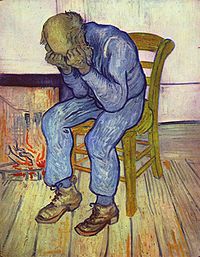 Depression in later life, traditionally defined as age older than 65, is associated with disability, increased mortality, and poorer outcomes.
 Compared to younger adults with depression:
- cognitive and functional impairment and anxiety are more common in older adults
- older adults with depression are at increased risk of suicide
Depression is associated with cognitive impairment and an increased risk of dementia.
A selective serotonin reuptake inhibitor (SSRI) should be the first line pharmacological treatment for depression for most older adults.
Psychological and drug treatment is as effective in older as in younger adults
References:
Depression in older adults. Rodda et al. BMJ, 2011.
Image source: Vincent van Gogh's 1890 painting At Eternity's Gate. Wikipedia, public domain.

Friday, January 6, 2012
Why Mayo Clinic is a power user of social media: "Our patients are doing it, so this is where we need to be"
Mayo Clinic's first-ever Social Media Residency took place October 20-21, 2011. At the end of the first day, the attendees went out on a video interview assignment. Check out some of the videos they returned with.
The best interest of the patient is the only interest to be considered
The Mayo Clinic CEO, John Noseworthy, M.D., pointed out recently that Mayo intends to be the leader in social media in healthcare but this is not about competitive advantage, it is about the patient. The best interest of the patient is the only interest to be considered. Social media makes the union of forces more broadly practical than at any time in human history.
Social Media and Medicine is a Good Marriage, says Mayo Clinic director for social media: We're judged more by how well we listen, than by what we say (http://goo.gl/0ECin).
If you work for Mayo Clinic, social media is not an option, it's a job requirement http://bit.ly/IHf3lM - Others will follow.
References:
Social media in medicine: How to be a Twitter superstar and help your patients and your practice
Thursday, January 5, 2012
Hands-only CPR videos - The American Way vs. The British Way - Celebrity edition
The American Heart Association (AHA) recruited Kendrick Kang-Joh Jeong, MD (a trained physician and an actor from the Hangover) to demonstrate ‘hands only CPR’ to the metronomic beat of the Bee Gees 1977 disco hit ‘Stayin’ Alive’:
The British Heart Foundation recruited footballer-turned-actor Vinnie Jones to show how hard and fast hands-only CPR to Stayin' Alive by the Bee Gees can help save the life of someone who has had a cardiac arrest. The Hollywood hardman is starring in a TV advert urging more people to carry out CPR in a medical emergency:
Ken Jeong Behind the Scenes - AHA CPR video:
Comments from YouTube:
Sure, the beat to "Staying Alive" works, but so does "Another One Bites The Dust" by Queen......... just saying!
Related reading:
Disco Still Saves Lives. Life in the Fast Lane.
The British Heart Foundation recruited footballer-turned-actor Vinnie Jones to show how hard and fast hands-only CPR to Stayin' Alive by the Bee Gees can help save the life of someone who has had a cardiac arrest. The Hollywood hardman is starring in a TV advert urging more people to carry out CPR in a medical emergency:
Ken Jeong Behind the Scenes - AHA CPR video:
Comments from YouTube:
Sure, the beat to "Staying Alive" works, but so does "Another One Bites The Dust" by Queen......... just saying!
Related reading:
Disco Still Saves Lives. Life in the Fast Lane.
Wednesday, January 4, 2012
The Third Component of Genetic Blueprint - Writing in Pen (DNA) vs. Pencil (Epigenetics)
The term epigenetics refers to changes in phenotype (appearance) or gene expression caused by mechanisms other than changes in the underlying DNA sequence, hence the name epi- (Greek: over; above) -genetics. There is no change in the underlying DNA sequence of the organism; the phenotype is expressed by activating some genes while inhibiting others. Epigenetics includes changes in gene function that occur without a change in the sequence of DNA. These changes occur as a result of the interaction of the environment with the genome. Epigenetic determinants activate or silence fetal genes through alterations in DNA, histone methylation and acetylation.

DNA associates with histone proteins to form chromatin. Image source: Wikipedia, GNU Free Documentation License.
From the National Geographic magazine:
"Mother Nature writes some things in pencil and some things in pen. Things written in pen you can't change. That's DNA. But things written in pencil you can. That's epigenetics. Now that we're actually able to look at the DNA and see where the pencil writings are, it's sort of a whole new world."
If you think of our DNA as a piano keyboard and our genes as keys - each key symbolizing a segment of DNA responsible for a particular note, or trait, and all the keys combining to make us who we are - then epigenetic processes determine when and how each key can be struck, changing the tune being played.
Recent studis focuses on a particular epigenetic process called DNA methylation, which is known to make the expression of genes weaker or stronger.
The good news is that some of these processes, unlike our DNA sequences, can be altered. Genes muted by methylation, for example, sometimes can be switched back on again relatively easily. And though it may not happen soon, the hope is that someday epigenetic mistakes will be as simple to repair as a piano that's out of tune. "

Human chromosomes (grey) capped by telomeres (white). Image source: Wikipedia, public domain.
References:
Twins. National Geographic magazine, 01/2012.
Portrait of twins: series one and series two from National Geographic.
Twins Data Reshaping Nature Versus Nurture Debate. NPR.
Epigenetics, Wikipedia.

DNA associates with histone proteins to form chromatin. Image source: Wikipedia, GNU Free Documentation License.

From the National Geographic magazine:
"Mother Nature writes some things in pencil and some things in pen. Things written in pen you can't change. That's DNA. But things written in pencil you can. That's epigenetics. Now that we're actually able to look at the DNA and see where the pencil writings are, it's sort of a whole new world."
If you think of our DNA as a piano keyboard and our genes as keys - each key symbolizing a segment of DNA responsible for a particular note, or trait, and all the keys combining to make us who we are - then epigenetic processes determine when and how each key can be struck, changing the tune being played.
Recent studis focuses on a particular epigenetic process called DNA methylation, which is known to make the expression of genes weaker or stronger.
The good news is that some of these processes, unlike our DNA sequences, can be altered. Genes muted by methylation, for example, sometimes can be switched back on again relatively easily. And though it may not happen soon, the hope is that someday epigenetic mistakes will be as simple to repair as a piano that's out of tune. "

Human chromosomes (grey) capped by telomeres (white). Image source: Wikipedia, public domain.

References:
Twins. National Geographic magazine, 01/2012.
Portrait of twins: series one and series two from National Geographic.
Twins Data Reshaping Nature Versus Nurture Debate. NPR.
Epigenetics, Wikipedia.
Tuesday, January 3, 2012
"The online version is the official journal of record, not the print edition". Start a blog in 2012
 "The online version is the official journal of record", wrote the Editor-in-Chief and the editorial staff of Pediatrics, the official journal of the the American Academy of Pediatrics:
"As we start 2012, and welcome the more than 6 million annual visitors to our journal's Web site, we remind our readers that the online version, not the shorter print edition, is the official journal of record. Is it time to do away with the print version? Probably not just yet, but it may not be long until we are heading in that direction.
If you are thinking, “there are so many options to peruse and so little time!” you will find some highlights of each issue in our blog - First Read - which contains previews of articles of interest selected by members of our executive editorial board. We are even running some of our most interesting “fillers” from the print journal in the blog so they are not missed by our online readers"
This is the URL of the blog which is hosted for free on Blogger.com by Google: http://pediatricsblog.blogspot.com
All physicians should consider starting a blog in 2012
I would encourage all physicians to start a blog in 2012 - here is why (quotes from an interview with Seth Godin and Tom Peters):
"Blogging is free. It doesn’t matter if anyone reads it. What matters is the humility that comes from writing it. What matters is the metacognition of thinking about what you’re going to say.
No single thing in the last 15 years professionally has been more important to my life than blogging. It has changed my life, it has changed my perspective, it has changed my intellectual outlook, it’s changed my emotional outlook. And it’s free."
Don't limit yourself to your blog - use Facebook, Twitter and Google Plus
Blogging can be great for personal growth but there is a lot more interaction on Twitter, Facebook and Google Plus nowadays as compared to blogs. If you have a blog, you must also have a Facebook "like" page (previously called "fan" page), a Twitter account, and probably a Google Plus page. These serve the dual purpose of distribution and commenting channels ("two-way street").
For example, Facebook pages get a lot more interaction than blogs for some medical journals - you can compare the number of comments on the NEJM Facebook updates (the range is 9-180) vs. their blog (0). The blog has comments enabled, of course.
Facebook is the clear "winner" in terms of commenting activity, it is not even close:
NEJM Facebook page vs. NEJM blog
This is a suggested simple project for all doctors in 2012:
1. Start on Twitter (microblog).
2. Continue on Blogger/WordPress.
3. Make an impact. Improve the quality of online health information and tell the public your side of the story.
How to Create a Blog on Blogger in 5 minutes (Google video):
Help your patients and your practice
I developed the concept of Two Interlocking Cycles:
- Cycle of Patient Education
- Cycle of Online Information and Physician Education
The two cycles work together as two interlocking cogwheels (TIC):
References:
Taking the Pulse of Pediatrics. PEDIATRICS Vol. 129 No. 1 January 1, 2012, pp. 168 -169 (doi: 10.1542/peds.2011-3288).
Social media in medicine: How to be a Twitter superstar and help your patients and your practice
Patients directed to online tools don't necessarily use them: 25% checked website vs. 42% read same material on paper. Am Medical News, 2012.
Subscribe to:
Posts (Atom)