Saturday, July 30, 2011

100-year-old doctor still practicing at UCSF, shares unconventional longevity secrets

Even though he recently turned 100, Dr. Ephraim Engleman still sees arthritis patients regularly at the University of California San Francisco (UCSF). He has some rather unconventional longevity secrets to share:

"I think exercise is mostly overrated. And the use of vitamins, forget it. And I don't encourage a lot of doctors.

Fall in love and get married. Sex is to be encouraged. Children are a priority."

His two sons are physicians. His daugher, a lawyer, is a married to a doctor, and their son is a physician.

From NBC’s Nightly News:

Visit msnbc.com for breaking news, world news, and news about the economy


The extended 17-minute version of the report is embedded below:

Visit msnbc.com for breaking news, world news, and news about the economy


Comments from Twitter:

@theRealAnubis: Hum...If he was right, 1/2 of the world population would reach 100 yrs.... For what I see about his case, money is the biggest ally..

Mayo Clinic on procedure competency: "140 colonoscopies isn't cool. You know what's cool, 275 colonoscopies"


Mayo Clinic: GI professional organizations have traditionally recommended that gastroenterology (GI) fellows perform 140 colonoscopies before assessing competency. Robert E. Sedlack, M.D., of the Department of Gastroenterology and Hepatology at Mayo Clinic, discusses findings that suggest it takes an average of 275 procedures to acquire the skills needed to perform safe and effective exams.

The quote is from here:

"The Social Network" tells the story of how Facebook went from a college startup to essentially the only way that old friends keep in touch. Napster founder-turned-Facebook president Sean Parker gives site creator Mark Zuckerberg, some shrewd financial advice. "A million dollars isn't cool. You know what's cool? A billion dollars," he says.

Friday, July 29, 2011

How much heat you can take? 232 years ago, three British gentlemen found out

Have you ever wondered how much heat you can take? 232 years ago, three British gentlemen decided to find out: 260 degrees Fahrenheit (126.6 degrees Celsius).

From NPR:


Be sure to check the cartoon slideshow too.

Wednesday, July 27, 2011

What happens when you ask for medical advice on Twitter - CNN's Anderson Cooper knows from experience

What happens when you ask for medical advice on Twitter and you are CNN's host Anderson Cooper with 1.5 million followers:

Anderson Cooper
Anderson Cooper

Replies:

@thehighsign I generally just go with the opinion of a million and a half strangers.

@SashaTalebi Crazy times we're living in when @andersoncooper can crowdsource his bronchitis diagnosis via Twitter. Get well soon.

@JPLondon72 When a doctor says "You have bronchitis". Usually. Not always.

@emokidsloveme I feel like @andersoncooper has health insurance. Call me crazy, but I think he could afford to pay out of pocket too. #TwitterER

@Technikohler But why don't you just hit up good ole Gupta and ask him ?

@SadaoTurner hey @sanjayguptaCNN, do u know this guy @andersoncooper

@sherrybutlerpr Tight breathing, Burning in chest, fever. B careful, walking pneumonia

@LizaLizzieHalim i knew when i had troubled breathing&it makes sounds.Then i get the doctor checked&was diagnosed with it. Still have it now.

@lynngosselin I've had bronchitis many times so yes I know...but maybe a Dr. will pick up your post

@feathersong Two words - doctor, antibiotics. Make that three words - stat. Feel better soon, you've got a show to do!

@EldinaV And use a mist vaporizer in your dream and lots of OJ

@teresac8 fever, cough, wheezing and irritated breathing but to be sure see a doctor.

@cheeki3 well you want to the homeopathic route. Oregano oil (diluted in juice) will knock it right out.#justsaying

@sherrybutlerpr Also coughing up phlegm. Get on meds. U don't slow down, so will need that or will really go down. Take good care.

Acute bronchitis: Many patients expect to be treated with antibiotics and cough meds but this differs from guidelines


Mind map of differential diagnosis of cough. See more Allergy and Immunology mind maps here.

Cough is the most common symptom bringing patients to the primary care physician's office. The most common diagnosis in these patients is acute bronchitis, according to a recent review in the official journal of AFP, American Family Physician.

Acute bronchitis should be differentiated from other common causes of cough such as pneumonia and asthma - because the therapies are clearly different.

Symptoms of acute bronchitis typically last 3 weeks. As we already know, the presence of colored (e.g., yellow or green) sputum does not reliably differentiate between bacterial and viral lower respiratory tract infections. This statement was contradicted by a recent study: Green or yellow phlegm likely to be bacterial - confirming beliefs by doctors and patients alike (http://goo.gl/zff8X and http://goo.gl/cwKGs).

Viruses cause more than 90% of acute bronchitis, and therefore, antibiotics are generally not indicated. They should be used only if pertussis is suspected to reduce transmission or if the patient is at increased risk of developing pneumonia (e.g., patients 65 years or older).

The typical therapies that have been traditionally used for managing acute bronchitis symptoms have been shown to be ineffective. The U.S. Food and Drug Administration recommends against using cough and cold preparations in children younger than 6 years.

The supplement pelargonium may help reduce symptom severity in adults.

Many patients expect to be treated with antibiotics and cough medications but this differs from evidence-based recommendations.

References:
Diagnosis and treatment of acute bronchitis. Albert RH. Am Fam Physician. 2010 Dec 1;82(11):1345-50.

Tuesday, July 26, 2011

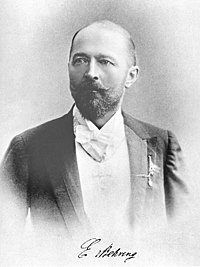
Medicine's first Nobel laureate

Medicine's first Nobel laureate was Emil von Behring (1854-1917). He was the discoverer of diphtheria antitoxin in 1890 and attained a great reputation in his lifetime but also was a subject of controversy:

Behring’s unabashed pursuit of financial rewards for his efforts — unusual in that era—drew much criticism. One of the first modern medical entrepreneurs, he aggressively sought to patent his discoveries, and profited handsomely from their applications. This conflicted with the more genteel notions that prevailed at the time, which venerated physicians as selfless servants of mankind.

For all his accomplishments, Behring was a deeply troubled man. He suffered from frequent bouts of profound depression, and was institutionalised several times.

The great discoverer of serum therapy died of pneumonia in Marburg on March 31, 1917.

References:
Emil von Behring (1854-1917): Medicine's first Nobel laureate. Singapore Med J. 2011 Jan;52(1):1-2 (free full text PDF).
Image source: Emil Adolf von Behring, Wikipedia, public domain.

Monday, July 25, 2011

How to apply sunscreen


NHSChoices: An expert explains why it is important to protect your skin from sunburn to help avoid skin cancer. She also gives advice on how to apply sunscreen correctly and what to look out for when buying sunscreen.

You get exposed to both UVA and UVB light:

- UVB light is the light that Burns (causes sunburn)
- UVA light as the light that Ages the skin (wrinkles, etc.)

There is 8-10% increase in sun exposure for every 1,000 feet of elevation. In the summertime, you can get anywhere from 40-50% greater sun intensity than at sea level

Related reading:

Only 25% of Children Wear Sunscreen Regularly. WebMD, 2012.

Wednesday, July 20, 2011

How much vitamin D do you need? Distilling strong advice from weak evidence

Vitamin D is a steroid hormone and a component of a complex endocrine pathway sometimes called 'vitamin D endocrine system' (Medscape, 2012).

From Nature News:

Vitamin D has been lauded in the media for preventing or treating multiple disease but most evidence is circumstantial or weak.

Despite this, some physicians recommend supplementation of up to 6,000 international units (IU) to compensate for the time that people spend indoors. This is less than what a fair-skinned person make in 30 minutes of exposure to the summer sun (without sunscreen).

The amount spent on vitamin-D supplements in the United States had risen 10-fold in 10 years.

Poor data is one reason that the IOM panel did not recommend higher doses for vitamin D supplementation in 2010. The IOM 1,000-page report recommended that people should aim for blood levels of 50 nanomoles per litre (nmol/L).

However, according to the Endocrine Society's guidelines:

- people with levels under 50 nmol/L are "vitamin-D deficient"
- those with levels between 50 nmol/L and 72.5 nmol/L are "insufficient"

The society's guidelines also offer an 'ideal' level of 100–150 nmol/L which would require 1,500–2,000 IU daily. It advises physicians to monitor vitamin-D levels in healthy people.

Quest Lab already began to implement these deficiency and insufficiency standards over the IOM's. Many physicians are expected to follow suit.

A vitamin D3 dosage of 800 IU/d increased serum 25-(OH)D levels to greater than 50 nmol/L in 97.5% of women http://bit.ly/GzBCcA

References:

The vitamin D-lemma. 6 July 2011 | Nature 475, 23-25 (2011) | doi:10.1038/475023a
Image source: Wikipedia, public domain.

Comments from Google+:

Neil Mehta - This sounds like deja vu' all over again. How many times have we been down this path? vitamin C, Vitamin E, Carotenes....

Common themes:

The myth of natural products: "it is a natural product so it can't cause harm can it?" Thus if a little bit of it is good, more must be better.
The research problem: "It is over the counter and present in foods so very difficult to determine how much someone is actually taking"
Huge confounder of observational studies: "People who take supplements, other "health products" are different from those who don't.