Showing posts with label History. Show all posts

Tuesday, July 26, 2011

Medicine's first Nobel laureate

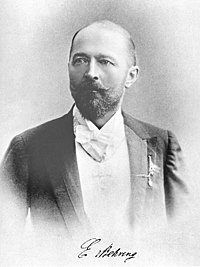
Medicine's first Nobel laureate was Emil von Behring (1854-1917). He was the discoverer of diphtheria antitoxin in 1890 and attained a great reputation in his lifetime but also was a subject of controversy:

Behring’s unabashed pursuit of financial rewards for his efforts — unusual in that era—drew much criticism. One of the first modern medical entrepreneurs, he aggressively sought to patent his discoveries, and profited handsomely from their applications. This conflicted with the more genteel notions that prevailed at the time, which venerated physicians as selfless servants of mankind.

For all his accomplishments, Behring was a deeply troubled man. He suffered from frequent bouts of profound depression, and was institutionalised several times.

The great discoverer of serum therapy died of pneumonia in Marburg on March 31, 1917.

References:
Emil von Behring (1854-1917): Medicine's first Nobel laureate. Singapore Med J. 2011 Jan;52(1):1-2 (free full text PDF).
Image source: Emil Adolf von Behring, Wikipedia, public domain.

Wednesday, October 6, 2010

First official antismoking campaign was launched in 1604 by James I of England

From the BMJ:

Monarchs and their heirs are not always noted for their rational medical advice. But James VI of Scotland, who became James I of England in 1603, was different.

Published anonymously in 1604 but immediately credited to the king, A Counterblaste to Tobacco flew in the face of prevailing medical opinion by outlining some of the chief health risks of smoking more than three centuries before scientists made the connection.

Possibly the first official antismoking campaign, the royal pamphlet highlighted cost and passive smoking as two of the most powerful arguments against tobacco, while it lamented that addiction, peer pressure, and fashion were among the most difficult obstacles to overcome.


A Counterblaste to Tobacco is written in Early Modern English and refers to medical theories of the time (e.g. the four humours). In it, King James I blames Native Americans for bringing tobacco in Europe, complains about passive smoking, warns of dangers to the lungs, and decries tobacco's odour as "hatefull to the nose."

James's dislike of tobacco led him to authorize an excise tax and tariff of six shillings and eight pence per pound of tobacco imported, or £1 per three pounds, a large sum of money for the time.

References:
Royal insights on smoking - Moore 340: c1408 - BMJ.
Image source: James I, VI by John de Critz, c.1606, Wikipedia, public domain.
A Counterblaste to Tobacco. Wikipedia.

Twitter comments:

@CardioNP: 400+ yrs later I still wade thru smoke to enter the hospital.

Wednesday, December 23, 2009

Thursday, December 3, 2009

Hysteria: Historical Perspective


"Women under hysteria" from Wikipedia. D.M. Bourneville and P. Régnard, public domain.

From The Lancet:

The changing meanings of hysteria have mirrored the preoccupations of the societies that used the term:

Ancient Egyptians, and subsequently Greeks, blamed a displaced hystera, or womb, for many women's afflictions, including choking, mutism, and paralysis, although the term hysteria was not applied until later.

Hippocratic writings speak of a dry womb rising towards the throat in search of moisture, thereby impeding breathing.

As anatomical knowledge increased, such notions became untenable and Galen instead blamed blocked menstrual flow and sexual abstinence.

Galen suggested that retained sperm could contribute to male hysteria, igniting a debate which was to run for centuries over whether men could indeed suffer hysteria.

Psychiatrists have gradually replaced the term "hysteria" with "somatization disorder". In 1980 the American Psychiatric Association officially changed the diagnosis of "hysterical neurosis, conversion type" to "conversion disorder".

References:
Hysteria, Perspectives. The Lancet, Volume 374, Issue 9702, Page 1669, 14 November 2009.
Hysteria. Wikipedia.
Somatoform Disorder: Conversion. eMedicine Specialties > Pediatrics: Developmental and Behavioral > Medical Topics.