Showing posts with label chocolate. Show all posts

Friday, October 28, 2011

Chocolate consumption is inversely associated with coronary heart disease

Cocoa and dark chocolate are rich in flavonoids and may lower blood pressure.

5,000 people aged 25-93 years participated in the National Heart, Lung, and Blood Institute (NHLBI) Family Heart Study.

Compared to subjects who did not report any chocolate intake, odds ratios for coronary heart disease (CHD) were:

- 1.0 for subjects consuming chocolate 1-3 times/month
- 0.74 for subjects consuming chocolate 1-4 times/week
- 0.43 for subjects consuming chocolate 5+ times/week

Consumption of non-chocolate candy was associated with a 49% higher prevalence of CHD comparing 5+/week vs. none per week [OR = 1.49].

Consumption of chocolate is inversely related with prevalent CHD in a general United States population.

References:

Chocolate consumption is inversely associated with prevalent coronary heart disease: the National Heart, Lung, and Blood Institute Family Heart Study. Djoussé L, Hopkins PN, North KE, Pankow JS, Arnett DK, Ellison RC. Clin Nutr. 2011 Apr;30(2):182-7. Epub 2010 Sep 19.
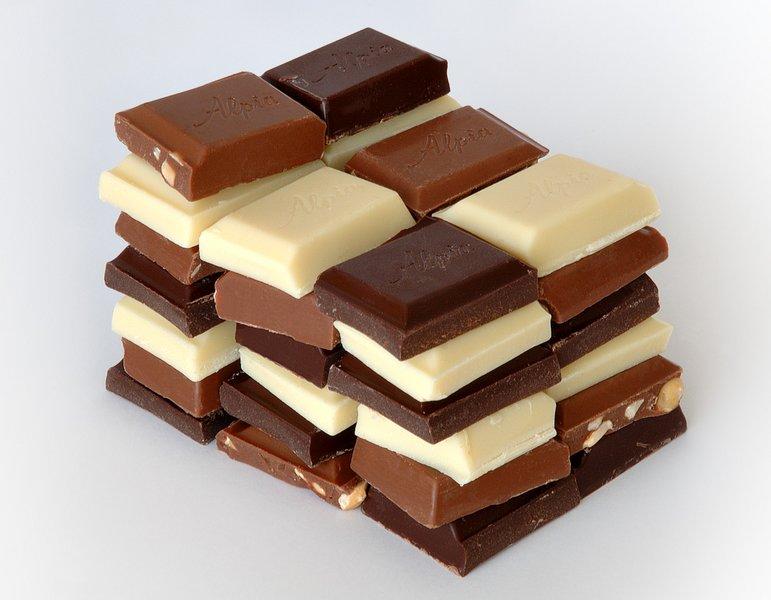
Image source: Wikipedia, public domain.

From Writer's Almanac:

Ode to Chocolate by Barbara Crooker (excerpt)

I hate milk chocolate, don't want clouds
of cream diluting the dark night sky,
don't want pralines or raisins, rubble
in this smooth plateau. I like my coffee
black, my beer from Germany, wine
from Burgundy, the darker, the better.

Saturday, May 22, 2010

Health benefits of chocolate

The health benefits of chocolate may include:

- Reduction of blood pressure by eating 6 grams of dark chocolate per day. Probably due to the flavonol epicatechin
- Reduction of platelet and endothelial cell activation
- Reduction of inflammatory mediators
- It can also inhibit oral caries
- It can cross the blood brain barrier and increase cerebral blood flow in humans

From Writer's Almanac:

Ode to Chocolate by Barbara Crooker (excerpt)

I hate milk chocolate, don't want clouds
of cream diluting the dark night sky,
don't want pralines or raisins, rubble
in this smooth plateau. I like my coffee
black, my beer from Germany, wine
from Burgundy, the darker, the better.

References:
The Essence of Chocolate. Dr Shock MD PhD, 2010.
Chocolate could lower blood pressure but the required dose may be too much - BMJ http://goo.gl/uoBN
Chocolate linked to substantial reduction in risk of cardiometabolic disorders but evidence not of best quality. BMJ, 2011.
Photo Essay: Making Chocolate in Belize http://goo.gl/2DPi
Image source: Wikipedia, public domain.

Sunday, May 9, 2010

Eating chocolate with high flavanol levels can protect the skin from UV light

Cocoa beans fresh from the tree are exceptionally rich in flavanols. Unfortunately, during conventional chocolate making, this high antioxidant capacity is greatly reduced due to manufacturing processes.

The researchers evaluated the photoprotective potential of chocolate consumption, comparing:

- conventional dark chocolate
- specially produced chocolate with preserved high flavanol (HF) levels.

A double-blind in vivo study in 30 healthy subjects was conducted, 15 subjects were randomly assigned to either a high flavanol (HF) or low flavanol (LF) chocolate group and consumed a 20 g portion of their allocated chocolate daily.

The minimal erythema dose (MED) was assessed at baseline and after 12 weeks.

In the high flavanol (HF) chocolate group the mean MED more than doubled after 12 weeks of chocolate consumption, while in the LF chocolate group, the MED remained without significant change.

The authors concluded that regular consumption of a chocolate rich in flavanols confers significant photoprotection and can thus be effective at protecting human skin from harmful UV effects. However, conventional chocolate has no such effect.


Video: Chocolate Rain by Tay Zonday.

References:
Eating chocolate can significantly protect the skin from UV light. Williams S, Tamburic S, Lally C. J Cosmet Dermatol. 2009 Sep;8(3):169-73.
Link via @DrShock.
Photo Essay: Making Chocolate in Belize http://goo.gl/2DPi
Chocolate linked to substantial reduction in risk of cardiometabolic disorders but evidence not of best quality. BMJ, 2011.
Image source: Wikipedia.

Related:

Monday, March 12, 2007

Why Chocolate is Not a Health Food--Sigh

I've always loved chocolate--especially dark chocolate. But the recent flurry of stories that chocolate could be some kind of wonder food leaves a bad taste in my mouth. This falls into a category of stories that journalists love to report and consumers love to read: Hey, what you think is bad for you is actually good. (And let's not forget another closely related category: what you think is good