Showing posts with label COPD. Show all posts

Friday, December 16, 2011

Controversies in COPD treatment

Chronic obstructive pulmonary disease (COPD) is a chronic disorder with high mortality rates (one of the top 5 causes of death).

COPD is expected to rise to the third leading cause of death worldwide by 2030. More than 25% of COPD patients have never been smokers.

Some important controversies in COPD management still exist:

- The classic way to define COPD has been based on spirometric criteria, but more relevant diagnostic methods are needed that can be used to describe COPD severity and comorbidity

- Initiation of interventions earlier in the natural history of the disease to slow disease progression is debatable

- There are controversies about the role of inhaled corticosteroids (ICS) in the management of COPD

- Long-term antibiotics for prevention of exacerbation have had a resurgence in interest

New drugs are urgently needed for management of COPD exacerbation.

COPD is a complex disease and consists of several phenotypes that in future would guide its management.


Asthma Inhalers (click to enlarge the image). Advair and Symbicort are FDA-approved for treatment of COPD in the U.S.

References:

Controversies in treatment of chronic obstructive pulmonary disease. Prof Klaus F Rabe MD a , Jadwiga A Wedzicha MD b. The Lancet, Volume 378, Issue 9795, Pages 1038 - 1047, 10 September 2011.

New insights into the immunology of chronic obstructive pulmonary disease. The Lancet, Volume 378, Issue 9795, Pages 1015 - 1026, 10 September 2011.

COPD—more vigorous research needed. The Lancet, Volume 378, Issue 9795, Page 962, 10 September 2011.

Diagnosis and Management of COPD - Current Guidelines

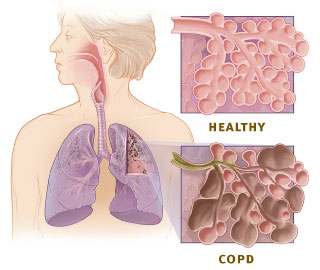
Image source: Enlarged view of lung tissue showing the difference between healthy lung and COPD, Wikipedia, public domain.

Friday, November 4, 2011

Diagnosis and Management of COPD - Current Guidelines

WHO estimates that 210 million people have COPD worldwide. COPD is the 4th leading cause of death in the world, but by 2030 it is expected to be the 3rd, behind CAD and stroke (http://bit.ly/X5nje). COPD mortality is inversely correlated to the forced expiratory volume (FEV1) in 1 second (http://bit.ly/ZYIR7).

Here are the key recommendations from the recently published Guidelines for management of stable chronic obstructive pulmonary disease (COPD):

1. Spirometry should be obtained to diagnose airflow obstruction in patients with respiratory symptoms. Spirometry should not be used to screen for airflow obstruction in individuals without respiratory symptoms.

2. For stable COPD patients with respiratory symptoms and FEV1 between 60% and 80% predicted, treatment with inhaled bronchodilators may be used.

3. For stable COPD patients with respiratory symptoms and FEV1 <60% predicted, inhaled bronchodilators should be used.

4. Clinicians should prescribe monotherapy using either long-acting inhaled anticholinergics (LAMA) or long-acting inhaled β-agonists (LABA) for symptomatic patients with COPD and FEV1 <60% predicted.

5. Clinicians may administer combination inhaled therapies (long-acting inhaled anticholinergics, long-acting inhaled β-agonists, or inhaled corticosteroids, LABA/ICS) for symptomatic patients with stable COPD and FEV1<60% predicted.

6. Clinicians should prescribe pulmonary rehabilitation for symptomatic patients with an FEV1 <50% predicted. Clinicians may consider pulmonary rehabilitation for symptomatic or exercise-limited patients with an FEV1 >50% predicted.

7. Clinicians should prescribe continuous oxygen therapy in patients with COPD who have severe resting hypoxemia (PaO2 ≤55 mm Hg or SpO2 ≤88%).

References:

Diagnosis and Management of Stable Chronic Obstructive Pulmonary Disease: A Clinical Practice Guideline Update from the American College of Physicians, American College of Chest Physicians, American Thoracic Society, and European Respiratory Society. ACP, 08/2011. Annals of Int Medicine, 2011.

Image source: Enlarged view of lung tissue showing the difference between healthy lung and COPD, Wikipedia, public domain.

Monday, December 13, 2010

COPD patients with anxiety have a higher risk of exacerbations

Psychological functioning is an important determinant of health outcomes in chronic lung disease.

COPD was associated with a greater risk of anxiety in multivariable analysis (OR 1.85). Among patients with COPD, anxiety was related to poorer health outcomes including worse submaximal exercise performance (less distance walked during the 6-min walk test) and a greater risk of self-reported functional limitations.

Subjects with COPD with anxiety had a higher risk of COPD exacerbations.

COPD is associated with a higher risk of anxiety. Once anxiety develops among patients with COPD, it is related to poorer health outcomes.

References:

Influence of anxiety on health outcomes in COPD. Eisner et al. Thorax 2010;65:229-234 doi:10.1136/thx.2009.126201
Action plan is a key component of self-management programs in patients with COPD. Thorax, 20111.

Comments:

Dr RW: I don't have the full text of this paper, and I wonder if they controlled for continued smoking. Nicotine is a powerful anxiolytic for some COPD patients.

Tuesday, August 17, 2010

2 in 3 people with known risk factors for COPD don't know they have the disease

One in five heavy smokers over age 40 have findings of COPD, but only one-third have been previously diagnosed with the common lung disease.

10% of people worldwide over the age of 40 are affected by COPD.

Researchers screened 1,003 people aged 40 and over who were current or former heavy smokers. Heavy smoking was defined as a smoking history of 20 pack-years or more.

The results showed that 20.7% of the people screened met the criteria for a diagnosis of COPD but only 32.7% had previously been diagnosed with the disease or were aware of their COPD diagnosis.

References:
Many Unaware They Have COPD. WebMD.
Image source: Lungs, Wikipedia, public domain.

Sunday, May 2, 2010

Tiotropium for COPD: A good foundation therapy for most patients

From a BMJ Editorial:

Tiotropium is a once daily, inhaled, long acting anticholinergic drug (LAMA) that provides 24 hour improvement in airflow and hyperinflation in patients with chronic obstructive pulmonary disease (COPD).

Clinical trials have consistently shown that these physiological effects translate into improvements in:

- lung function
- exercise tolerance
- health related quality of life
- fewer exacerbations

References:
Tiotropium and chronic obstructive pulmonary disease. BMJ, 2010.
http://www.bmj.com/cgi/content/short/340/feb19_1/c833
Image source: Wikipedia, public domain.

Thursday, April 15, 2010

Vitamin D deficiency occurs frequently in COPD and correlates with severity

Vitamin D is a steroid hormone and a component of a complex endocrine pathway sometimes called 'vitamin D endocrine system' (Medscape, 2012).  1 in 4 individuals will develop COPD during their lifetime (Lancet, 2011).

Serum 25-hydroxyvitamin D (25-OHD) levels were measured in 414 (ex)-smokers older than 50 years and the link between vitamin D status and presence of COPD was assessed. The rs7041 and rs4588 variants in the vitamin D-binding gene (GC) were genotyped and their effects on 25-OHD levels were tested.

In patients with COPD, 25-OHD levels correlated significantly with forced expiratory volume in 1 s (FEV1).

Compared with 31% of the smokers with normal lung function, as many as 60% and 77% of patients with GOLD (Global Initiative for Obstructive Lung Disease) stage 3 and 4 exhibited deficient 25-OHD levels lower than 20 ng/ml.

25-OHD levels were reduced by 25% in homozygous carriers of the rs7041 at-risk allele.

76% and 100% of patients with GOLD stage 3 and 4 homozygous for the rs7041 allele exhibited 25-OHD levels lower than 20 ng/ml.

Vitamin D deficiency occurs frequently in COPD and correlates with severity of COPD. The data warrant vitamin D supplementation in patients with severe COPD, especially in those carrying at-risk rs7041 variants.

Despite this circumstantial evidence, a recent trial of vitamin D replacement in patients with COPD did not show a reduction in exacerbations unless the patients had a severe vitamin D deficiency.

References:
Vitamin D deficiency is highly prevalent in COPD and correlates with variants in the vitamin D-binding gene. Thorax 2010;65:215-220 doi:10.1136/thx.2009.120659.
http://thorax.bmj.com/content/65/3/215.short
A vitamin D3 dosage of 800 IU/d increased serum 25-(OH)D levels to greater than 50 nmol/L in 97.5% of women http://bit.ly/GzBCcA 
Image source: Lungs, Wikipedia, public domain.