Tuesday, May 15, 2012

Best of Medical Blogs - weekly review and blog carnival

The “Best of Medical Blogs - BMB weekly review and blog carnival” is a weekly summary of the best posts from medical blogs. Feel free to send your suggestions to my email at clinicalcases@gmail.com. Best of Medical Blogs (BMB) is published every Tuesday, just like the old Grand Rounds.

A Medical Educator Joins Social Media: One Year Later

Dr. Djuricich, Program Director in Medicine-Pediatrics at the Indiana University, shares what he has learned in one short year: If physicians and other health care professionals are not becoming involved in social media, they are missing out on a “place” where many of the patients already are. There is a lot of misinformation floating around on the internet. It is a duty of physicians to combat this and provide correct information. Do not let social media take over your life. The important things (family, friends, etc.) are still the important things, so don’t lose the priorities. http://goo.gl/zNfpe

What explains blogging longevity? It's easy: blog for yourself, and share with others

Dr. Centor explains his blogging longevity after 10-years of blogging. I've been blogging for 8 years, and I agreee with him: Why you should write a blog for yourself rather than for a shifting audience http://goo.gl/P8xtz

Here's Dr. Centor again: Explaining longevity is subjective. Mostly, I like blogging. Basically I blog with myself in mind, and am gratified that others find my comments interesting. Blogging is never a chore. One cannot last 10 years doing a chore. http://goo.gl/Jyl2o

Cardiologist Dr. Wes nominates the hardest to read Abstract of the Year at 2012 Heart Rhythm Society

What is the abstract that contributes the smallest amount to our field while demonstrating the worst grammar, the most bureaucratic lingo and, of course, verbosity. The sentence that clinched it? "Conclusions: The harmonization of endpoint definitions, terminology, and clinical trial design paradigms provides consistency across clinical trial studies that can facility (sic) clinician acceptance of results and the evaluation of safety and effectiveness of devices and medicines for atrial fibrillation." http://goo.gl/ZstA0

Harvard Medical School Q&A blog doctor reflects on his readers’ feedback

Dr. Komaroff from the blog Ask Doctor K.: “Since I began this column last September, I’ve received a lot of mail — both emails and “snail mail.” Mostly it’s been health questions. I can’t answer them all, but I try to answer as many as I can. However, I’ve also received complaints. Sometimes they represent an honest difference of perspective. On occasion, they reflect the fact that I’m a man.” http://goo.gl/XK3O1

A complete list of all academic medical journals available for the iPad

The omnipresent blog iMedicalApps makes a good use of Google Docs spreadsheet to list the apps of many academic medical journals available for the iPad. I still have personal preference for the open web rather than apps but that’s just me. http://goo.gl/13Gjz

What is postinfectious cough and how to treat it?

From Dr. Matthew Mintz' blog: While the cause of the postinfectious cough is not known, it has been thought to be due to the extensive damage of cells lining the lung and widespread airway inflammation of the upper and/or lower airways. The good news is that this usually goes away by itself, the bad news is that it can take weeks or even months, and can be quite disruptive to patients lives. Since symptoms are caused primarily by inflammation and hyperresponsiveness/bronchoconstriction in the lungs (which is what we see in asthma), then treatment is likely best with something that treats both inflammation and bronchoconstriction in the lungs, such as an inhaled corticosteroid/long-acting beta agonist like Advair (which is commonly used in asthma). Use of Advair for postinfectious cough may be the single most common off-label use of any prescription product. Since inflammation can persist for weeks, it is important that Advair be used for at least 4 weeks. If symptoms return, the patient should be brought back for pulmonary function testing as this may be a new presentation of asthma. http://goo.gl/RgxLb

Reality Social Media: Live Tweeting Brain Surgery. What is the downside of this marketing push? Dr. Wes explains: http://goo.gl/XbKwv

"Healthcare Going To The Dogs" - a video for training hospital administrators http://goo.gl/hv40a and http://goo.gl/xsW4J

Science blogging and self-promotion? http://goo.gl/yGUqS

Monday, May 14, 2012

Depression affects up to 9% of U.S. population - how to do effective screening?

From American Family Physician:

Depression affects up to 9% of U.S. population.

The U.S. Preventive Services Task Force recommends screening in adolescents and adults but it does not recommend screening for depression in children 7-11 years of age, or screening for suicide risk in the general population.

The Patient Health Questionnaire (PHQ)-2 and PHQ-9 are commonly used and validated screening tools.

The PHQ-2 has a 97% sensitivity and 67% specificity in adults. The PHQ-2 inquires about the frequency of depressed mood and anhedonia over the past 2 weeks, scoring each as 0 ("not at all") to 3 ("nearly every day").

PHQ-9 has a 61% sensitivity and 94% specificity in adults. The PHQ-9 depression module scores each of the 9 DSM-IV criteria as “0” (not at all) to “3” (nearly every day).

If the PHQ-2 is positive for depression, the PHQ-9 should be administered.

In older adults, the 15-item Geriatric Depression Scale is an appropriate follow-up test.

If these screening tests are positive for depression, further evaluation is needed to confirm that the patient's symptoms meet the Diagnostic and Statistical Manual of Mental Disorders' (DSM) criteria for diagnosis.

References:

Screening for depression. Maurer DM. Am Fam Physician. 2012 Jan 15;85(2):139-44.

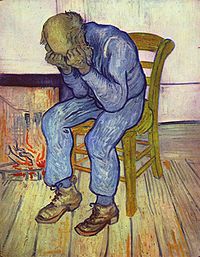
Image source: Vincent van Gogh's 1890 painting At Eternity's Gate. Wikipedia, public domain.

Saturday, May 12, 2012

Top articles in medicine in May 2012

Here are my suggestions for some of the top articles in medicine in May 2012 so far:

Is Geriatric Medicine Terminally Ill? asks Annals of Internal Medicine http://goo.gl/J4jMU

Low vitamin D (below 50 nmol/L (20 ng/mL) increases risk for clinical disease among older adults http://goo.gl/tBXS4

Senior physicians keep working, putting off the R-word - 20% of U.S. physicians are older than 65 http://goo.gl/Dxgip

Many young doctors worried about future of medicine - amednews http://goo.gl/r61lW

"One of the greatest risks of social media is ignoring social media" says chief integrity officer of Cleveland Clinic. Patients want to use social media tools to manage health care http://goo.gl/9SAry

Doctors can risk lawsuits when writing about patients - amednews points to books about patients as examples http://goo.gl/QhqFS

Coffee is the most complex food known to man. It has 1200 flavor components. The nearest comparison is red wine with 450 chemical compounds in the flavor make-up. In most commercial blends there are 10 to 12 different coffees, from different farms. http://goo.gl/m2LwD

Guidelines for social media use by Federation of State Medical Boards (FSMB) describe in detail what NOT to do: http://goo.gl/Raq2e

Prevention of acute knee injuries in adolescent female football (soccer) players: warm-up could help http://goo.gl/dBgSS

Is It Possible To Walk And Work At The Same Time? Kaiser Permanente tries walking meetings http://goo.gl/cRu8l

Corneal transplantation - 2012 state of the art review in The Lancet http://goo.gl/JBAag

Towards an optimum strategy in rheumatoid arthritis: For RA patients who fail initial methotrexate treatment, add-on disease-modifying antirheumatic drugs are appropriate http://goo.gl/ONq6u

Time Spent Behind the Wheel May Increase Heart Health Risks, linked to less time spent exercising http://goo.gl/NUYX7

Recipe For Safer Drinking Water (from bacteria)? Add Sun, Salt And Lime http://goo.gl/kU2ZK

The articles were selected from my Twitter and Google Reader streams.

Friday, May 11, 2012

Healthcare social media - top articles

Here are my suggestions for some of the top articles related to healthcare social media in the past 2 weeks:

Healthcare social media is a moral obligation

Healthcare social media is a 'moral obligation', says Farris Timimi, M.D., medical director for the Mayo Clinic Center for Social Media. Social media needs to be grown and nurtured for patients. "Our patients are there. Our moral obligation is to meet them where they're at and give them the information they need so they can seek recovery," Timimi said. "You've got to be ready for it. You build it for the patients; not for yourself. "This is not marketing," he added. "This is the right thing to do." http://goo.gl/BHzKf

The New World Of Medical Tweeting

300 million users generate 300 million messages every day, and doctor are part of it. 38% of tweets are conversational - transferring information and spreading content. Twitter can be a strong educational tool.

The American Medical Association has released a public statement about professionalism in social media:

“Participating in social networking and other similar internet opportunities can support physicians’ personal expression, enable individual physicians to have a professional presence online, foster collegiality and camaraderie within the profession, provide opportunity to widely disseminate public health messages and other health communication." http://goo.gl/K2QtK

Guidelines for social media use by Federation of State Medical Boards (FSMB) describe in detail what NOT to do: http://goo.gl/Raq2e

Digital Strategies for Healthcare Organisations http://goo.gl/PZtWl

Use of Social Media by Western European Hospitals: Longitudinal Study shows that SoMe awareness is growing http://goo.gl/l41tz

Doctors can risk lawsuits when writing about patients - amednews points to books about patients as examples http://goo.gl/QhqFS

GruntDoc: It’s my 10th Blogging Anniversary http://goo.gl/TkBc7 - Congratulations! A great reflection on a long journey.

The articles were selected from my Twitter and Google Reader streams.

Thursday, May 10, 2012

Dermatology Art Contest by Mayo Clinic shows that art can be seen in every aspect of life

A Mayo Clinic dermatology art contest shows beauty really is skin deep. From Mayo Clinic News blog:

A hair follicle or skin specimen that doesn’t look like much of anything to the naked eye can become a complex, colorful work of art under a microscope. The winner of the Mayo dermatologists’ first art contest in 2011 was “Hair Follicle Triplet”. Alexander Meves, M.D., used fluorescent dyes to highlight proteins. The inaugural winners of the art contest appeared in the May issue of the Journal of Cutaneous Pathology.

“Every single day, dermatopathologists get to see beautiful images under the microscope, and most people never have the opportunity to see that. So I thought it would be a nice way to show not only the science of dermatopathology, but also the art,” says the contest’s creator, Dr. Lehman, a Mayo Clinic dermatopathologist.


Dr. Lehman hopes medical societies will run with the idea and hold similar competitions to highlight aesthetics in their specialties. People in other lines of work can also celebrate the beauty of what they do each day, she says.

Editor's note: Allergists should do something similar. We already highlight beautiful pollen allergens on the monthly covers of the ACAAI journal.

“Art can be seen in every aspect of life,” Dr. Lehman says. “You just have to have an open mind and be looking for it.”

References

Dermatology Art Shows Beauty Really Is Skin Deep. Mayo Clinic News.

Wednesday, May 9, 2012

Diary-Writing Has Psychological Benefits - Journal of Happiness Studies

Writing has long been used as a coping strategy and has been applied to improve psychological well-being. One study found that suicidal poets used more first-person singular pronouns (I, me, my) than the control group of poets.

This study from Taiwan, published in the Journal of Happiness Studies, investigated the psychological displacement paradigm in diary-writing (PDPD) and its supposed psychological benefits.

Study participants were randomly assigned to write about their recent negative life experiences two times a week for 2 weeks in PDPD group (diary-writing), or comparison group (no diary-writing).

The diary-writing group (PDPD) showed a decrease in negative emotion and an increase in positive emotion immediately after each writing session (short term effect).

They also had an increase in psychological well-being for at least 2 weeks (long term effect).

References:

The Psychological Displacement Paradigm in Diary-Writing (PDPD) and its Psychological Benefits. Jen-Ho Chang, Chin-Lan Huang and Yi-Cheng Lin. JOURNAL OF HAPPINESS STUDIES 2012, DOI: 10.1007/s10902-012-9321-y

Comments from Google Plus and Twitter:

Lin W: I guess blog writing might have the same effect?

Ves Dimov, M.D.: It depends on the type of blogging you do, but yes, blogging can be a positive experience too.

Dr. Amal Hasan @DrFloona: Diary-Writing Has Psychological Benefits bit.ly/wwMDmr” Until someone else reads it

Dean Giustini @giustini: Diary-Writing Has Psychological Benefits bit.ly/wwMDmr [Isn't this why we blog Ves?]

@DrVes: Well, I'm not sure. I don't blog about "negative experiences". Blog = archive for me

Tuesday, May 8, 2012

Best of Medical Blogs - weekly review, blog carnival

The “Best of Medical Blogs - weekly review, blog carnival” is a weekly summary of the best posts from medical blogs. Feel free to send your suggestions to my email at clinicalcases@gmail.com. Best of Medical Blogs is published every Tuesday, just like the old Grand Rounds.

Social Networks for Doctors: Are We There, Yet?

Twitter can be as inane, or as useful, as the accounts you follow. Sure, doctors use Facebook like everyone else, but – by and large – they haven’t tapped into the educational potential that online social networks offer. Once viewed as a trivial hobby by more eminent researchers and writers, blogs now serve as the elder statesmen of social media - and they can act as a base of operations for social networking. An excellent summary by Shiv Gaglani & Nicholas Genes: http://goo.gl/9DVbI

A Twitter Primer for Physicians (aka Twitter 101 for Docs)

Here are Dr. Ryan Madanick's suggestions: http://goo.gl/gNS5d. Dr. Madanick is a gastroenterologist at the University of North Carolina School of Medicine, as well as the Program Director for the GI & Hepatology Fellowship Program.

1. Consider starting with a private account.

2. Start following some accounts: Specialty societies and journals, let Twitter suggest some accounts, search for accounts with similar interests.

3. Listen to what others are saying.

4. Decide what to tweet.

5. Find a hashtag.

The incredible frailty of life

Realizing the incredible frailty of life and the battle to avoid irrational exuberance: a journey into the NICU as a Med-Peds uncle. This is a heartfelt article by Dr. Moises Auron from Cleveland Clinic: http://goo.gl/KvUbN

The NYTimes gets it wrong on ECG screening of young athletes

Dr. John Mandrola, a cardiac electrophysiologist, comments on a NYTimes article that included numerous inaccuracies and failed to tell important facts about the complexities of widespread screening of athletes. http://goo.gl/siEEp

How one patient uses Social Media

"Personally.. I don’t want to be a patient.. It’s totally the last thing I want to be…Before my diagnosis I shamefully has no idea what Rheumatoid arthritis (RA) was or what the consequences were of having a Chronic Illness. Patients and Doctors will find a solution together." A guest post at Dr. Ronan Kavanagh's blog. Dr. Kavanagh is rheumatologist from Ireland: http://goo.gl/daRfd

Krokodil is a devastating homemade opiate

Krokodil (or crocodile) refers to homemade batches of the opiate desomorphine (currently available without a prescription in Russia), and ingredients such as gasoline, paint thinner, hydrochloric acid, iodine, and red phosphorous. When injected, this highly impure mixture often causes skin to turn greenish grey and scaly, which may explain the drug’s name. Another explanation is that subsequent ischemia, gangrene and amputation has the same effect as a crocodile biting off a victim’s limb. From The Poison Review: http://goo.gl/VAq28

How to straighten a guidewire with one hand

The Australian blog Life in the Fast Lane is one of the best blogs focused on emergency medicine. Here is one of their shorter posts: How to straighten a guidewire with one hand http://goo.gl/mC9zY

GruntDoc: It’s my 10th Blogging Anniversary http://goo.gl/TkBc7 - Congratulations! A great reflection on a long journey.

10 Bad Assumptions Patients Make - a post by Dr. Rob http://goo.gl/EpmUO

All papers at PLoS Medicine now reflect the public Twitter debate | Medical Museion http://goo.gl/Xmu5Y

Caffeine and Sleep In Kids: It is a good rule of thumb to avoid soda entirely | Craig Canapari, MD http://goo.gl/W5HGS

Using fruit to improving anaphylaxis care - use your expired injectable epinephrine on an orange, an allergists suggest http://goo.gl/AQIxw

Are we too concerned with confidentiality? Former BMJ editor provides a personal example: http://goo.gl/0J3dp

Comments from Twitter:

John Mandrola, MD @drjohnm: Thx 4 shout out. Wow, lots of other great posts.

Mike Cadogan @sandnsurf: Concise, pithy and diverse - great read

Craig Canapari @DrCanapari:  Honored to be included