Showing posts with label Sleep. Show all posts
Showing posts with label Sleep. Show all posts
Wednesday, January 18, 2012
Sleepwalking: Lee's story
From NHS Choices YouTube channel: Lee started sleepwalking at the age of four. In this video he describes his sleepwalking episodes, including doing artwork despite having no interest in art, plus the physical side effects when he wakes up.
Also watch Sleepwalking in children.

Wednesday, December 21, 2011
40% of police officers have a sleep disorder according to a JAMA study
More than a third of police officers have a sleep disorder, and those who do are more likely to experience heart disease, problems with job performance and rage toward suspects and citizens, says the NYTimes, citing a study in the JAMA. That figure is at least double the estimated 15-20% rate of sleep disorders seen in the general population.
Having a sleep disorder raised the odds of heart disease by 45%, and the odds of depression by 120%. It also raised the odds of being injured on the job by 22% and falling asleep while driving by 51%.
The JAMA report video.
The officers who had sleep disorders reported more instances of “uncontrolled anger” toward suspects and citizens and serious administrative errors. Sleep deprivation may affect the amygdala, a part of the brain where emotion is governed.
Of the 5,000 study participants, 40% screened positive for at least 1 sleep disorder, most of whom had not been diagnosed previously:
- 34% screened positive for obstructive sleep apnea
- 6.5% for moderate to severe insomnia
- 5.4% for shift work disorder
Not surprisingly, the police officer who had smaller body mass indexes were far less likely to have sleep apnea. System-wide practices can have a significant impact. For example, state police officers in Massachusetts are given one hour of paid exercise time four days a week to help them stay fit. They were less liekly to have sleep apnea.
References:
Sleep Problems in Police Officers Take Heavy Toll. NYTimes.
Sleep Disorders, Health, and Safety in Police Officers. JAMA.
Comments from Twitter:
WendySueSwanson MD (@SeattleMamaDoc): Geesh.
@CrumbedOxygen: wonder if EMS similar.
Dr John Weiner @AllergyNet: Can CPAP Cure Cops?
Martin Wilson @ChInspMWilson: what is CPAP then ...??
@DrVes CPAP (continuous positive airway pressure) is a treatment option for sleep apnea. Here is more info from the Mayo Clinic: http://www.mayoclinic.com/health/cpap/MM00716
Having a sleep disorder raised the odds of heart disease by 45%, and the odds of depression by 120%. It also raised the odds of being injured on the job by 22% and falling asleep while driving by 51%.
The JAMA report video.
The officers who had sleep disorders reported more instances of “uncontrolled anger” toward suspects and citizens and serious administrative errors. Sleep deprivation may affect the amygdala, a part of the brain where emotion is governed.
Of the 5,000 study participants, 40% screened positive for at least 1 sleep disorder, most of whom had not been diagnosed previously:
- 34% screened positive for obstructive sleep apnea
- 6.5% for moderate to severe insomnia
- 5.4% for shift work disorder
Not surprisingly, the police officer who had smaller body mass indexes were far less likely to have sleep apnea. System-wide practices can have a significant impact. For example, state police officers in Massachusetts are given one hour of paid exercise time four days a week to help them stay fit. They were less liekly to have sleep apnea.
References:
Sleep Problems in Police Officers Take Heavy Toll. NYTimes.
Sleep Disorders, Health, and Safety in Police Officers. JAMA.
Comments from Twitter:
WendySueSwanson MD (@SeattleMamaDoc): Geesh.
@CrumbedOxygen: wonder if EMS similar.
Dr John Weiner @AllergyNet: Can CPAP Cure Cops?
Martin Wilson @ChInspMWilson: what is CPAP then ...??
@DrVes CPAP (continuous positive airway pressure) is a treatment option for sleep apnea. Here is more info from the Mayo Clinic: http://www.mayoclinic.com/health/cpap/MM00716
Tuesday, October 4, 2011
Reading on iPad before bed disrupts sleep - Kindle is OK, with the exception of Kindle Fire
As well know, the iPad contains a touchscreen liquid crystal display that, like computer screens and television sets, emits light. Exposure to such abnormal light sources inhibits the body's secretion of melatonin.
All light-emitting devices, including cellphones, "tell the brain to stay alert." Because users hold those devices so close to their face, staring directly into the light, the effect is amplified compared with, for example, a TV across the room or a bedside lamp.
All light-emitting devices, including cellphones, "tell the brain to stay alert." Because users hold those devices so close to their face, staring directly into the light, the effect is amplified compared with, for example, a TV across the room or a bedside lamp.
References:
Reading on iPad before bed can affect sleep habits. LA Times.
Comments from Twitter:
Related products from Amazon:Reading on iPad before bed can affect sleep habits. LA Times.
Comments from Twitter:
@UChicagoMed: Is that mostly from the light? The Kindle app and Instapaper both have dark modes that aren't as bright.
Comments from Twitter:
@DrVes: Why are some doctors and nurses giving back their iPads? http://j.mp/Hq15aD - Easy: iPad works great for pt education, NOT for data entry. Only 10% of doctors currently use an iPad at work http://j.mp/Hq15aD - I use iPad daily to discuss these diagrams: http://j.mp/Hq1k5v
iPad is a great teaching tool @CraigCCRNCEN was able to explain to Vietnamese family AFib and clots by showing them animation from YouTube.
Brian S. McGowan PhD @BrianSMcGowan: so is the best option for docs still a touch screen laptop? teach w/ touch screen, work w/ full keyboard? #hcsm
@DrVes: iPad works well for discussing DDx, Tx options with pts. Much more portable than laptop. Full-keyboard COWs best for typing.
Jeff Bray @jeffkbray: I have been scanning all my medical reference books and store them on my iPad for quick use and no weight - great tool and mobile
Comments from Twitter:
@DrVes: Why are some doctors and nurses giving back their iPads? http://j.mp/Hq15aD - Easy: iPad works great for pt education, NOT for data entry. Only 10% of doctors currently use an iPad at work http://j.mp/Hq15aD - I use iPad daily to discuss these diagrams: http://j.mp/Hq1k5v
iPad is a great teaching tool @CraigCCRNCEN was able to explain to Vietnamese family AFib and clots by showing them animation from YouTube.
Brian S. McGowan PhD @BrianSMcGowan: so is the best option for docs still a touch screen laptop? teach w/ touch screen, work w/ full keyboard? #hcsm
@DrVes: iPad works well for discussing DDx, Tx options with pts. Much more portable than laptop. Full-keyboard COWs best for typing.
Jeff Bray @jeffkbray: I have been scanning all my medical reference books and store them on my iPad for quick use and no weight - great tool and mobile
Wednesday, September 14, 2011
A doctor who loves night shifts
 Emergency medicine physician, world-class educator and blogger extraordinaire Dr. Mike Cadogan was recently interviewed by Elsevier Australia:
Interviewer:
What are the best and worst parts of night shifts? Do you have any tips for surviving nights?
Mike Cadogan:
I love night shifts. The dark corridors, the cool air, the rising moon, the autonomy of decision-making, the authority, the midnight snacks and the sense of joyous achievement walking home with the sun rising and against the tide of tired, depressed faces gripping their morning coffees and bemoaning the need to be at work on such a glorious sunny day…
Think positive, be strong and enjoy autonomy. Remember that everybody else is on night shift with you, and most of them don’t want to be there either…but there is no need to be grumpy, rude, or pompous. Make friends with the night owls and collaborate, you will find your workload will dramatically decrease… Make enemies with the permanent night staff at your peril!
References
Interview with Mike Cadogan, author of the acclaimed On Call: Principles and Protocols by Student Ambassador Emma Sharp.
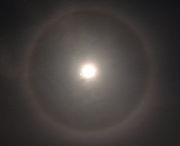
Image source: A halo around the Moon. Wikipedia, GNU Free Documentation License.

Tuesday, June 14, 2011
Sleep Habits Differ by Ethnicity but All Groups Are Sleep Deprived
All ethnic groups said they missed work or family functions because they were too sleepy, with the percentage ranging up to 24%, according to a 2010 "Sleep in America" survey by the National Sleep Foundation (NSF).Some distinct differences are listed below:
On weekdays or workdays, African Americans reported they slept the least - 6 hours, 14 minutes, compared to 6 hours, 34 minutes for Hispanics, 6 hours, 48 minutes for Asians, and 6 hours, 52 minutes for Caucasians.
10% of African Americans and Hispanics reported having sex every night or nearly every night in the hour before bedtime, compared to 4% of Caucasians and 1% of Asians.
African Americans had different pre-bedtime activities and tended to pray in the hour before bedtime - 71% of them said they prayed but only 18% of Asians did so.
Asians were least likely to drink alcohol an hour before bed - a practice that many mistakenly think will help sleep. Only 1% of Asians had a nightcap every night or nearly every night, compared to 7% of whites, 4% of African Americans and Hispanics.
Caucasians were most likely to sleep with their pets - as well as more likely to sleep with their spouse or significant others: 16% of them say they sleep with a pet, and 72% say they sleep with their partners. In comparison, only 4% of Asians, 4% of Hispanics, and 2% of African Americans let the pet on the bed.
References:
The 2010 Sleep in America poll by the National Sleep Foundation (NSF).
Sleep Habits Vary by Ethnicity. WebMD, 2010.
Sleepiness and sleep-disordered breathing may be found in 19-29% of children with positive allergy test (http://goo.gl/AfCWZ).
Sleepiness and sleep-disordered breathing may be found in 19-29% of children with positive allergy test (http://goo.gl/AfCWZ).
Image source: A halo around the Moon. Wikipedia, GNU Free Documentation License.
Saturday, May 14, 2011
Night shift workers are fighting ancient rhythms that order them to hunt or forage
From the National Geographic Magazine:We sleep 1.5 hour less a night than we did just 100 years ago
We fight these forces at our peril. Harvard's researchers note that going without sleep for 24 hours or getting only 5 hours of sleep a night for a week is the equivalent of a blood alcohol level of 0.1 percent. Yet modern business ethic celebrates such feats. "We would never say, 'This person is a great worker! He's drunk all the time!' "
A 2004 study included 2,700 first-year medical residents. These young men and women worked shifts that were as long as 30 hours twice a week. The research revealed the remarkable public health risk that this sleep debt entailed. "We know that one out of five first-year residents admits to making a fatigue-related mistake that resulted in injury to a patient. One in 20 admits to making a fatigue-related mistake that resulted in the death of a patient. One day people will look back on what will be viewed as a barbarous practice."
We sleep on average 1.5 hour less a night than we did just a century ago. Some of our epidemic of insomnia or sleeplessness is probably just our refusal to pay attention to our biology. The natural sleep rhythms of teenagers would call for a late morning wake-up—but there they are, starting high school at 8 a.m.
The night shift worker sleeping in the morning is fighting ancient rhythms in his or her body that order him or her awake to hunt or forage when the sky is flooded with light. Yet he or she has no choice.
We fight these forces at our peril. Harvard's researchers note that going without sleep for 24 hours or getting only 5 hours of sleep a night for a week is the equivalent of a blood alcohol level of 0.1 percent. Yet modern business ethic celebrates such feats. "We would never say, 'This person is a great worker! He's drunk all the time!' "
One in 20 medical residents admits to making a fatigue-related mistake that resulted in the death of a patient
A 2004 study included 2,700 first-year medical residents. These young men and women worked shifts that were as long as 30 hours twice a week. The research revealed the remarkable public health risk that this sleep debt entailed. "We know that one out of five first-year residents admits to making a fatigue-related mistake that resulted in injury to a patient. One in 20 admits to making a fatigue-related mistake that resulted in the death of a patient. One day people will look back on what will be viewed as a barbarous practice."
References:
The Secrets of Sleep. National Geographic Magazine, 2011.
Image source: A halo around the Moon. Wikipedia, GNU Free Documentation License.
Monday, January 10, 2011
How to succeed? Get more sleep
In this 4-minute talk, Arianna Huffington (founder of The Huffington Post) shares a small idea that can awaken much bigger ones: the power of a good night's sleep. Instead of bragging about our sleep deficits, she urges us to sleep our way to increased productivity and happiness -- and smarter decision-making.
Quotes from the talk:
"I was recently having dinner with a guy who bragged that he had only gotten four hours sleep the night before. And I felt like saying to him, "You know what? If you had gotten five, this dinner would have been a lot more interesting."
There is now a kind of sleep deprivation one-upmanship. Especially here in Washington, if you try to make a breakfast date, and you say, "How about eight o'clock?" they're likely to tell you, "Eight o'clock is too late for me, but that's okay, I can get a game of tennis in and do a few conference calls and meet you at eight." And they think that means that they are so incredibly busy and productive, but the truth is they're not."
Monday, September 13, 2010
People who get less than 6 hours sleep per night have an increased risk of dying prematurely
People who get less than 6 hours sleep per night had an increased risk of dying prematurely in a recent study. Those who slept for less than that amount of time were 12% more likely to die early, though researchers also found a link between sleeping more than 9 hours and premature death.The study aggregated decade-long studies from around the world involving more than 1.3 million people and found "unequivocal evidence of the direct link" between lack of sleep and premature death.
Just one sleepless night can hamper the body's ability to use insulin to process sugar in the bloodstream. Insulin sensitivity is not fixed in healthy people, but depends on the duration of sleep in the preceding night.
"Society pushes us to sleep less and less," one of the study investigators said, adding that about 20% of the population in the United States and Britain sleeps less than 5 hours.
Adults typically need between 7 and 9 hours sleep a night. If you sleep little, you can develop diabetes, obesity, hypertension and high cholesterol.
Image source: A halo around the Moon. Wikipedia, GNU Free Documentation License.
Thursday, August 19, 2010
"Sleep eaters" binge on sugary, high-calorie snacks, sometimes 5 times a night
Consequences of nighttime eating can include injuries like black eyes from walking into a wall or hand cuts from a prep knife, or dental problems from gnawing on frozen food.Upwards of 10 percent of adults suffer from some sort of parasomnia, or sleep disorder, like sleepwalking or night terrors. Some have driven cars or performed inappropriate sexual acts — all while in a sleep-induced fog. About 1 percent, mostly women, raid the refrigerator.
Image source: A halo around the Moon. Wikipedia, GNU Free Documentation License.
Monday, May 10, 2010
Can a Midday Nap Make You Smarter? Adults Who Nap for 90-minutes at 2 PM Learn and Perform Better at Tests
 According to a new study, if you devote your lunch hour to a nap, you may perform and learn better in the afternoon.
Napping at midday, when the brain's ability to learn may have deteriorated, may clear the brain's memory "storage area" and make room for new information.
In the study, the nap group was given the chance for a 90-minute siesta at 2 p.m.; the no-nap group was asked to stay awake.
People in the group which didn't nap had a 10% reduction in their learning capacity. The people who had a nap improved their ability to learn by 10% (not much).
References:
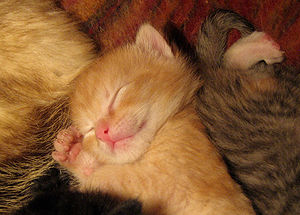
Image source: Sleeping kitten. Wikipedia, Tilman Piesk, public domain.

Saturday, April 17, 2010
Better Sleep, Better Learning? Obstructive sleep apnea can reduce a child’s IQ by 10 points
 From Science Life Blog at the University of Chicago:
 Pediatric obstructive sleep apnea, or OSA, can have long-term, detrimental effects on a child’s cardiovascular and respiratory health. But it can also create neurocognitive effects, such as a reduced ability to learn and retain information.
OSA can reduce a child’s IQ by as many as 10 points, while treatment in children with OSA can improve grades.
References:
OSA can reduce a child’s IQ by as many as 10 points, while treatment in children with OSA can improve grades.
References:
Better Sleep, Better Learning? « Science Life Blog « University of Chicago.
http://sciencelife.uchospitals.edu/2010/02/15/better-sleep-better-learning
http://sciencelife.uchospitals.edu/2010/02/15/better-sleep-better-learning
Sleep duration is shorter in obese children http://goo.gl/z5JFs
Sleepiness and sleep-disordered breathing may be found in 19-29% of children with positive allergy test (http://goo.gl/AfCWZ).
Sleepiness and sleep-disordered breathing may be found in 19-29% of children with positive allergy test (http://goo.gl/AfCWZ).
Friday, February 26, 2010
Chronic sleep loss decreases performance - One night of good sleep is not enough to recover from chronic sleep deficit
 On average, a person needs about eight hours a night to preserve performance.
Acute sleep loss is being awake for more than 24 hours in a row and chronic sleep loss is getting only about four to seven hours of sleep per night.
While most people caught up on acute sleep loss with a single night of 10 hours sleep, those with chronic sleep loss showed deteriorating performance for each hour spent awake.
People are largely unaware that they are chronically sleep-deprived but they are more vulnerable to sudden sleepiness, inattentiveness, and potentially, accidents and errors.
Three days is not enough to recover from chronic sleep loss, but they still do not know how many days or weeks may be needed.
References:
Chronic sleep loss hampers performance. Reuters, 2010.
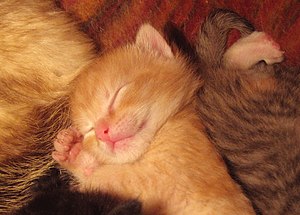
Image source: Sleeping kitten. Wikipedia, Tilman Piesk, public domain.
Monday, December 14, 2009
Is sleep the biggest mistake nature has made?
From the NYTimes:Scientists are not sure why sleep exists at all, it is hard to explain the great diversity of sleeping habits in different species. For example, why should lions get 15 hours a night and giraffes just 5?
“We spend a third of our life sleeping, and it seems so maladaptive - ‘the biggest mistake nature has made.' But another way of looking at it is: unnecessary wakefulness is a bigger mistake.”
My opinion: I do not think sleep can be qualified as a "mistake". In any case, if nature makes "mistakes", the evolution process gradually fixes them.
References:
Sleep May Be Nature’s Time Management Tool. NYTimes.
Sleepiness and sleep-disordered breathing may be found in 19-29% of children with positive allergy test (http://goo.gl/AfCWZ).
Image source: Sleeping kitten. Wikipedia, Tilman Piesk, public domain.
References:
Sleep May Be Nature’s Time Management Tool. NYTimes.
Sleepiness and sleep-disordered breathing may be found in 19-29% of children with positive allergy test (http://goo.gl/AfCWZ).
Image source: Sleeping kitten. Wikipedia, Tilman Piesk, public domain.
Subscribe to:
Posts (Atom)